Beyond the Graphics: 3 PC Games from Q1 2026 with Revolutionary Gameplay

Advertisements
Latest developments on revolutionary PC gameplay mechanics in 3 PC games from Q1 2026, with key facts, verified sources, and what readers need to monitor next in Estados Unidos, presented clearly in Inglês (Estados Unidos) (en-US).
Beyond the Graphics: 3 PC Games from Q1 2026 with Revolutionary Gameplay Mechanics is shaping today’s agenda with new details released by developers and industry insiders. This update prioritizes what changed, why it matters, and what to watch next, in a straightforward news format.
The focus remains firmly on innovative design, moving past mere visual enhancements to deliver truly novel interactive experiences. These upcoming titles promise to redefine player engagement and strategic depth within the PC gaming landscape.
The Dawn of New Interactive Paradigms
The gaming industry is currently witnessing a significant shift, prioritizing depth of interaction and emergent narratives over graphical fidelity alone. Developers are increasingly exploring uncharted territories in game design, aiming to deliver experiences that resonate on a deeper level.
Advertisements
This push for innovation is particularly evident in the highly anticipated Q1 2026 releases, where several titles are set to introduce groundbreaking mechanics. These games are not just visually stunning; they are fundamentally rethinking how players engage with virtual worlds.
The emphasis on revolutionary PC gameplay mechanics signifies a mature evolution in game development, where complex systems and player agency take center stage. This approach is poised to captivate a discerning audience seeking more than just high-resolution textures.
Project Chimera: Adaptive AI and Procedural Storytelling
Project Chimera, from independent studio Lumina Games, stands out for its ambitious adaptive AI system, which dynamically alters enemy behavior and environmental challenges based on player actions. This creates an unparalleled sense of unpredictability and replayability.
The game also integrates procedural storytelling, where narrative threads evolve organically from player choices and emergent gameplay scenarios. This ensures that no two playthroughs are ever identical, fostering a deeply personal and unique experience.
These innovative features position Project Chimera as a frontrunner in delivering truly revolutionary PC gameplay mechanics. Its design philosophy challenges traditional linear narratives, offering players genuine agency in shaping their journey.
Emergent Narrative Design
- Player choices directly influence character arcs and world events.
- Narrative branches are generated in real-time based on in-game actions.
- Consequences of decisions ripple through the entire game world, creating unique stories.
The core concept revolves around a living, breathing world that reacts intelligently to the player, making every decision feel impactful. This level of dynamic interaction promises to set a new standard for player immersion and long-term engagement.
Developers have stated that their goal is to move beyond static plot points, allowing players to truly author their own epic. This commitment to emergent storytelling is a critical component of its revolutionary PC gameplay mechanics.
Echoes of the Void: Quantum State Simulation
Echoes of the Void, developed by VoidForge Studios, introduces a quantum state simulation mechanic that allows players to manipulate probabilities and alternate realities. This system fundamentally redefines puzzle-solving and combat encounters.
Players can observe multiple potential outcomes simultaneously, then choose which reality to solidify, creating intricate tactical layers. This mechanic transforms every decision into a high-stakes gamble with far-reaching consequences.
The implementation of such a complex system highlights a commitment to revolutionary PC gameplay mechanics, pushing the boundaries of what is possible within a virtual environment. It demands strategic foresight and adaptability from players.
Probability Manipulation in Action
- Observe probabilistic outcomes of actions before committing.
- Shift environmental states by collapsing quantum possibilities.
- Utilize alternate realities for tactical advantage in combat.
This innovative approach to gameplay is expected to offer a profound sense of control and consequence, forcing players to think several steps ahead. The game’s design is a testament to pushing the envelope in interactive entertainment.
The developers have emphasized that mastering the quantum state simulation is key to progression, making it an integral part of the game’s identity and its revolutionary PC gameplay mechanics.
Chronostasis: Temporal Manipulation and Causal Loops
Chronostasis, from Temporal Dynamics, focuses on temporal manipulation, allowing players to rewind, fast-forward, and pause time within specific zones to solve complex environmental puzzles and overcome seemingly impossible obstacles. This goes beyond simple time-slow mechanics.
The game intricately weaves causal loops into its narrative and gameplay, where actions in the past directly influence future events, creating mind-bending paradoxes that players must navigate. This system offers unprecedented depth in puzzle design.
This sophisticated integration of time and causality positions Chronostasis as a prime example of revolutionary PC gameplay mechanics. It challenges players to think non-linearly and consider the ripple effects of their temporal interventions.
Navigating Causal Paradoxes
- Rewind time to correct past mistakes or create new opportunities.
- Fast-forward to observe future outcomes before making a move.
- Exploit temporal loops to bypass defenses or activate mechanisms.
The developers aim to deliver a narrative experience that is intrinsically linked to the temporal mechanics, making the manipulation of time not just a tool but a central theme. This creates a truly unique and immersive experience for players.
The intricate design of its time-bending systems makes Chronostasis a standout title, showcasing truly revolutionary PC gameplay mechanics that demand both intellect and creativity.
The Impact on Player Experience and Industry Standards
These games are not merely introducing new features; they are fundamentally reshaping player expectations for interaction and immersion. The emphasis on adaptive AI, quantum states, and temporal manipulation moves beyond superficial enhancements.
Players can anticipate a richer, more engaging experience where their decisions hold genuine weight and foster emergent narratives. This shift encourages deeper engagement and rewards critical thinking, moving away from purely reactive gameplay.
The success of these titles with their revolutionary PC gameplay mechanics will undoubtedly set new benchmarks for the industry, inspiring future developers to innovate further. This heralds a new era of complex and meaningful interactive entertainment.
Redefining Player Agency
- Players feel more in control of their unique game experience.
- Decisions have visible and impactful consequences on gameplay and narrative.
- The sense of ownership over the unfolding story is significantly enhanced.
The industry is watching closely to see how these ambitious designs are received by the wider gaming community. Their success could validate a new direction for game development, prioritizing creative mechanics over sheer graphical power.
This push for innovation demonstrates a commitment to evolving the medium, making revolutionary PC gameplay mechanics a cornerstone of future releases. It’s an exciting time for players seeking fresh experiences.
Technological Underpinnings of Advanced Mechanics
Achieving these complex gameplay mechanics requires significant advancements in underlying game engine technology and computational power. Developers are leveraging cutting-edge algorithms for AI and physics simulations, pushing hardware capabilities.
Cloud computing and advanced data processing are also playing a crucial role in managing the dynamic and emergent aspects of these games. This allows for more intricate simulations without overburdening local systems.
The integration of these technologies is essential for delivering truly revolutionary PC gameplay mechanics. It represents a synergy between creative design and robust engineering, making previously impossible concepts a reality.
Engine Innovations Driving Gameplay
- Advanced physics engines enabling realistic environmental interactions.
- Sophisticated AI pathfinding and decision-making algorithms.
- Real-time procedural generation for diverse content and scenarios.
These technological leaps are not just about making games look better; they are about enabling new forms of interaction and systemic depth. The focus is on creating responsive and believable virtual worlds.
The dedication to technical innovation underpins the promise of revolutionary PC gameplay mechanics, ensuring that these ambitious designs can be realized effectively and stably.
Anticipated Challenges and Developer Perspectives
Developing games with such complex and revolutionary PC gameplay mechanics presents numerous challenges, including extensive testing, balancing intricate systems, and managing player expectations. Developers face the task of making these systems intuitive yet deep.
Ensuring stability across a wide range of PC hardware configurations is also a significant hurdle. Optimization efforts are paramount to deliver a smooth experience for all players, regardless of their system specifications.
Despite these challenges, developers remain optimistic about the potential for these games to redefine the genre. They emphasize that the payoff in player engagement and unique experiences is well worth the effort.
Overcoming Development Hurdles
- Rigorous quality assurance to identify and fix emergent bugs.
- Extensive playtesting to fine-tune system balance and difficulty.
- Clear communication with players about the innovative nature of the mechanics.
The commitment to innovation often means pushing past conventional development cycles and embracing new methodologies. This dedication is crucial for bringing truly revolutionary PC gameplay mechanics to fruition.
Developers are actively engaging with communities to gather feedback, ensuring that these complex systems are not only ground-breaking but also genuinely enjoyable and accessible to a broad audience.
Market Reception and Future Outlook
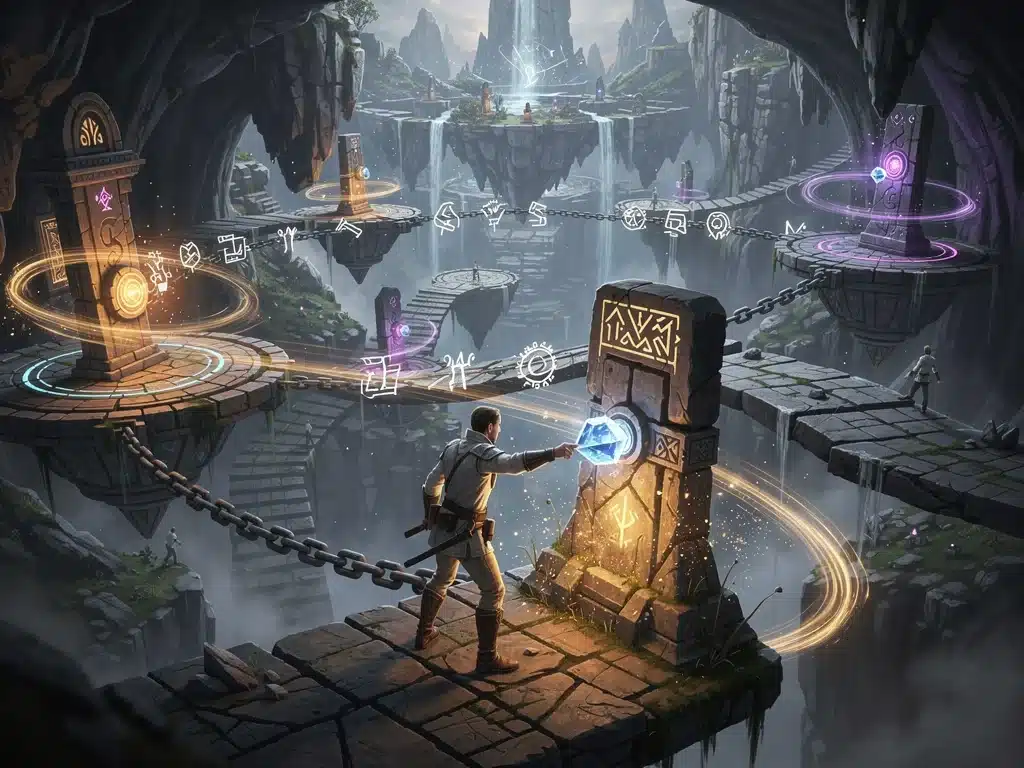
The market is showing considerable excitement for these upcoming titles, with pre-release buzz indicating strong player interest in games that offer something genuinely new. Analysts predict a positive reception, especially among players seeking deeper engagement.
The success of these games could pave the way for a new trend in the industry, encouraging more studios to invest in developing revolutionary PC gameplay mechanics rather than solely focusing on graphical upgrades.
This shift would benefit the entire gaming ecosystem, fostering greater creativity and diversity in game design. It marks a significant moment for the evolution of interactive entertainment.
Industry Trend Indicators
- Increased investment in R&D for game mechanics.
- Growing player demand for unique and challenging experiences.
- Positive media coverage highlighting innovative design over visuals.
The long-term impact of these games will be measured not just by sales figures but by their influence on future game development. They are poised to become case studies in how to successfully implement advanced interactive systems.
The anticipation surrounding these releases underscores a collective desire for revolutionary PC gameplay mechanics, promising an exciting future for the PC gaming landscape.
| Key Innovation | Brief Description |
|---|---|
| Adaptive AI | Enemy and environmental AI dynamically responds to player actions, creating unique challenges. |
| Quantum Simulation | Players manipulate probabilities and alternate realities for tactical advantage and puzzle solving. |
| Temporal Manipulation | Control time (rewind, fast-forward, pause) to solve puzzles and navigate causal loops. |
| Procedural Storytelling | Narrative arcs and events are generated organically based on player choices and emergent gameplay. |
Frequently Asked Questions About Revolutionary PC Gameplay
Revolutionary PC gameplay mechanics go beyond incremental improvements, introducing fundamentally new ways for players to interact with game worlds. This often involves complex systems like adaptive AI, quantum physics, or temporal manipulation, leading to emergent gameplay and unique player experiences not seen before in the industry.
These new mechanics significantly enhance replayability by ensuring that each playthrough offers a unique experience. Features like procedural storytelling and adaptive AI mean that challenges, narratives, and outcomes can differ dramatically, encouraging players to revisit games multiple times to explore all possibilities and emergent scenarios.
While these games introduce complex systems, developers are generally optimizing for a broad range of PC specifications. However, given the advanced AI, physics, and simulation elements, higher-end systems will likely provide the best experience. Specific requirements will be detailed closer to their Q1 2026 release dates.
While the initial focus for many of these titles with revolutionary PC gameplay mechanics appears to be on deep single-player experiences, some developers may explore integrating these systems into multiplayer modes. The complexity often makes it challenging, but the potential for innovative competitive or cooperative play is undeniable. Details vary by game.
Developers are focusing on intuitive design and gradual introductions to these complex mechanics. Tutorials and contextual hints will guide players, ensuring that while the underlying systems are deep, the player interface remains accessible. The goal is to offer depth without overwhelming new players, making revolutionary PC gameplay mechanics approachable.
Looking Ahead: The Future of PC Gaming
The emergence of revolutionary PC gameplay mechanics in Q1 2026 signifies a pivotal moment for the gaming industry. These titles are set to challenge established norms, pushing the boundaries of player interaction and narrative depth. The success of Project Chimera, Echoes of the Void, and Chronostasis will undoubtedly influence future development cycles, encouraging greater innovation beyond graphical fidelity.
This shift promises a more engaging and diverse landscape for PC gaming, where unique experiences take precedence. Players should monitor official announcements and developer insights as these groundbreaking games approach their release, as they are poised to redefine what is possible in interactive entertainment.