PCIe 5.0 on Gaming Hardware 2026: Upgrade Guide
Advertisements
The impact of PCIe 5.0 on gaming hardware in 2026 is becoming clearer, offering significant advancements for enthusiasts. This guide provides what you need to know for your next upgrade, focusing on performance, compatibility, and strategic planning. Understanding these changes is crucial for maximizing your gaming experience and investment.
The Impact of PCIe 5.0 on Gaming Hardware in 2026: What You Need to Know for Your Next Upgrade is a topic gaining considerable traction among PC enthusiasts and industry analysts. As we approach 2026, the adoption of PCIe 5.0 technology is set to redefine performance benchmarks across various components, particularly in high-end gaming rigs.
This article delves into the specifics of what PCIe 5.0 means for your gaming experience, from blazing-fast storage to more efficient graphics card communication. We will explore the tangible benefits, potential bottlenecks, and essential considerations for anyone planning a PC upgrade in the coming years, ensuring you are well-informed to make strategic decisions.
Understanding the nuances of this technological shift now will empower gamers to future-proof their systems and extract the maximum performance from their investments. The transition to PCIe 5.0 is not merely an incremental step but a foundational change that will enable new levels of gaming immersion and efficiency.
Advertisements
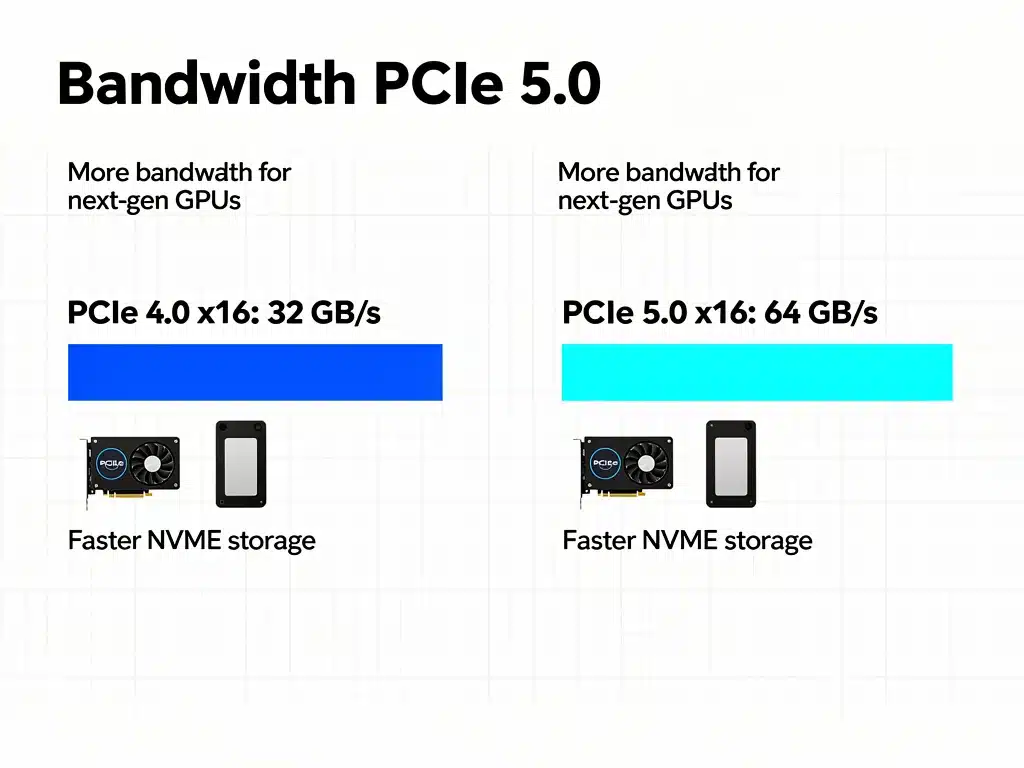
The advent of PCIe 5.0 brings a new era of data transfer speeds, fundamentally altering how components interact within a gaming PC. This standard doubles the bandwidth per lane compared to PCIe 4.0, leading to significant performance uplifts for compatible hardware.
For gamers, this translates into faster loading times, smoother gameplay, and potentially higher frame rates, especially in graphically intensive titles. The underlying architecture is designed to handle the increasing demands of next-generation games and applications.
As we look towards 2026, the widespread availability and optimization of PCIe 5.0 components will make it a crucial factor in building a top-tier gaming system. Early adopters are already seeing the benefits, setting a precedent for future upgrades.
Understanding PCIe 5.0: The Core Technology
PCIe 5.0, or Peripheral Component Interconnect Express 5.0, represents the latest iteration of the high-speed serial computer expansion bus standard. It offers a staggering 32 GT/s (gigatransfers per second) per lane, effectively doubling the 16 GT/s of PCIe 4.0.
This increased bandwidth is critical for components that require rapid data exchange with the CPU, such as graphics processing units (GPUs) and solid-state drives (SSDs). The specification was finalized by the PCI-SIG in 2019, with widespread adoption accelerating towards 2026.
Its implementation is not just about raw speed; it also enhances efficiency and enables new functionalities previously limited by bandwidth constraints. This technological leap is foundational for the next generation of computing.
Bandwidth and Throughput Explained
The core advantage of PCIe 5.0 lies in its unparalleled bandwidth, providing up to 128 GB/s in a x16 slot. This massive increase allows for significantly more data to be transferred simultaneously between components.
For gaming, this means less waiting for textures to load, quicker level transitions, and an overall more responsive system. The enhanced throughput directly impacts the fluidity and immersive quality of modern games.
This technical advancement sets the stage for future innovations in hardware design, pushing the boundaries of what’s possible in PC performance. The sustained high data rates are a game-changer for demanding applications.
- PCIe 5.0 offers 32 GT/s per lane, double PCIe 4.0’s 16 GT/s.
- A x16 PCIe 5.0 slot provides up to 128 GB/s bidirectional bandwidth.
- This translates to faster data transfer for GPUs and NVMe SSDs.
- Improved throughput reduces bottlenecks in high-performance systems.
Graphics Cards and PCIe 5.0: A New Era of Performance
Graphics cards are arguably the most bandwidth-hungry components in a gaming PC, and PCIe 5.0 is set to unlock their full potential. While current-generation GPUs may not fully saturate PCIe 4.0, future cards will undoubtedly leverage the extra headroom.
The increased bandwidth allows for more efficient communication between the GPU and the system memory, reducing latency and enabling larger texture streaming. This is particularly beneficial for games utilizing advanced rendering techniques and high-resolution assets.
By 2026, we anticipate that high-end graphics cards will be designed with PCIe 5.0 as a standard, making it a crucial consideration for any serious gamer. The Impact of PCIe 5.0 on Gaming Hardware in 2026: What You Need to Know for Your Next Upgrade will largely revolve around these GPU advancements.
DirectStorage and GPU Acceleration
DirectStorage, Microsoft’s API designed to accelerate game loading times, heavily benefits from PCIe 5.0. By allowing the GPU to directly access game assets from the SSD, it bypasses the CPU, significantly reducing overhead.
With PCIe 5.0, DirectStorage can achieve its maximum potential, delivering near-instantaneous loading and seamless transitions in games. This technology is a cornerstone of next-generation gaming experiences, leveraging the speed of modern hardware.
The synergy between PCIe 5.0, DirectStorage, and future GPUs promises a revolutionary shift in how games manage and load data. This is a key aspect of the impact of PCIe 5.0 gaming hardware.
- PCIe 5.0 enables faster texture streaming and reduced latency for GPUs.
- DirectStorage leverages PCIe 5.0 for direct GPU access to SSDs, bypassing the CPU.
- This combination leads to significantly faster game loading and asset management.
- Future GPUs will be optimized to fully utilize PCIe 5.0 bandwidth, enhancing gaming performance.
PCIe 5.0 SSDs: Unprecedented Storage Speeds
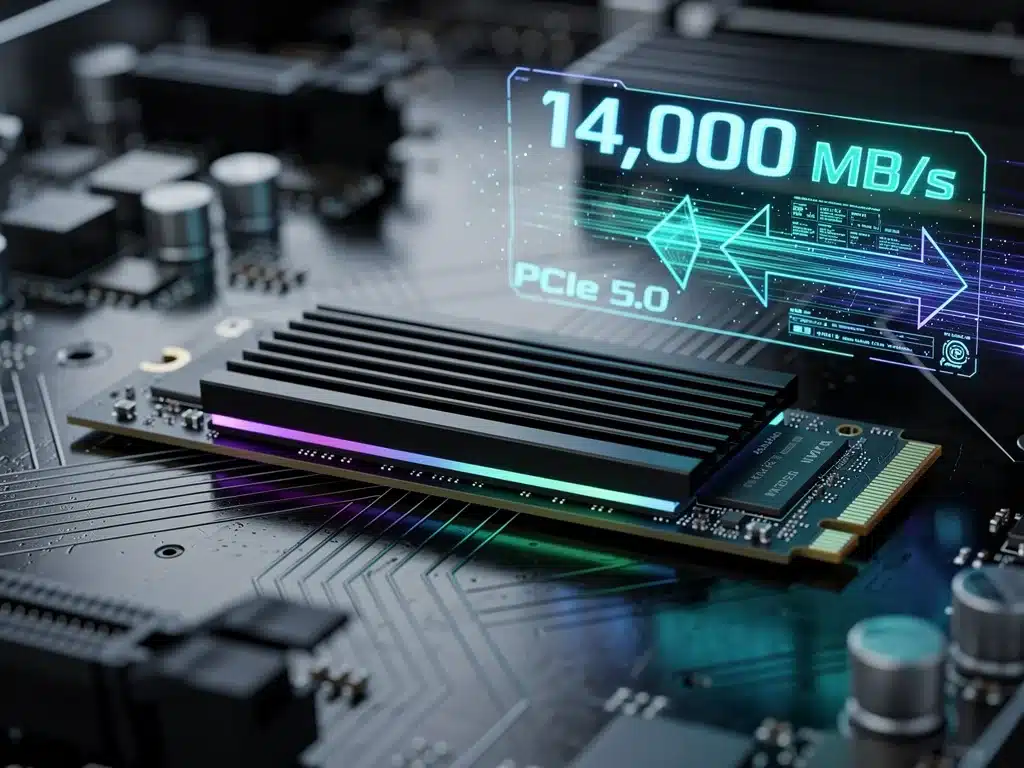
Perhaps the most immediate and noticeable impact of PCIe 5.0 is on NVMe solid-state drives. PCIe 5.0 SSDs offer sequential read and write speeds that significantly surpass their PCIe 4.0 counterparts, often doubling them.
This means load times for games, applications, and operating systems are dramatically cut down, almost to the point of being instantaneous. For gamers, this translates to less waiting and more playing, enhancing the overall user experience.
As game file sizes continue to grow, the speed of PCIe 5.0 SSDs becomes increasingly vital, making them a cornerstone of any high-performance gaming PC in 2026. The Impact of PCIe 5.0 on Gaming Hardware in 2026: What You Need to Know for Your Next Upgrade must include storage considerations.
Beyond sequential speeds, the improved random read/write performance of PCIe 5.0 SSDs is also critical for gaming. This affects how quickly small, scattered data files are accessed, which is common in game environments.
The responsiveness of a system is greatly enhanced by these faster random operations, contributing to a smoother and more fluid gaming experience. This subtle yet powerful improvement is a testament to the advantages of the new standard.
Investing in a PCIe 5.0 SSD is a forward-thinking decision that will pay dividends in terms of speed and responsiveness for years to come. It’s a key component of the impact of PCIe 5.0 gaming hardware.
Motherboard and CPU Compatibility: The Foundation
To harness the power of PCIe 5.0, your motherboard and CPU must support the standard. Currently, Intel’s 12th, 13th, and 14th Gen Core processors (LGA 1700 socket) and AMD’s Ryzen 7000 series (AM5 socket) are compatible.
These platforms feature chipsets and CPU designs that natively integrate PCIe 5.0 lanes, providing the necessary infrastructure for next-gen components. Without a compatible motherboard and CPU, you will not be able to utilize PCIe 5.0 devices at their full speed.
When planning your upgrade for 2026, ensuring your core components are PCIe 5.0 ready is paramount. This foundational compatibility is where the real impact of PCIe 5.0 gaming hardware begins.
Chipset Requirements and Future-Proofing
Specific chipsets are required to enable PCIe 5.0 functionality. For Intel, this includes the Z690, Z790, and B760 chipsets, while AMD utilizes the X670E, X670, B650E, and B650 chipsets. These chipsets manage the routing of PCIe lanes.
Choosing a motherboard with native PCIe 5.0 support ensures that your system is ready for future upgrades, even if you don’t immediately adopt PCIe 5.0 devices. This is a crucial step in future-proofing your build.
Considering the rapid pace of technological advancement, investing in a PCIe 5.0 compatible platform now will save you from another costly motherboard and CPU upgrade down the line. It’s an essential part of understanding the impact of PCIe 5.0 gaming hardware.
- Intel 12th, 13th, 14th Gen Core (LGA 1700) and AMD Ryzen 7000 series (AM5) CPUs support PCIe 5.0.
- Compatible chipsets include Intel Z690/Z790/B760 and AMD X670E/X670/B650E/B650.
- Native PCIe 5.0 motherboard support is essential for utilizing next-gen components.
- Future-proofing your system involves selecting a platform with current PCIe 5.0 capabilities.
The Real-World Benefits for Gamers in 2026
While theoretical speeds are impressive, the practical benefits of PCIe 5.0 for gamers in 2026 are what truly matter. The most significant advantage will be seen in games that are optimized for faster asset loading and streaming.
Expect drastically reduced loading screens, seamless texture pop-in, and a more consistent frame rate, especially in open-world titles. These improvements contribute to a more fluid and immersive gaming experience, reducing interruptions.
The collective impact of PCIe 5.0 on gaming hardware in 2026 will transform how games are designed and played, pushing developers to create even more expansive and detailed virtual worlds. This evolution is central to the gaming landscape.
Beyond Raw Speed: Efficiency and Latency
Beyond raw bandwidth, PCIe 5.0 also brings improvements in efficiency and reduced latency. The improved communication protocols mean less time waiting for data to travel between components, which can have a subtle yet noticeable effect on responsiveness.
Lower latency can translate to a more immediate feeling of control in fast-paced games, where every millisecond counts. This often overlooked aspect is just as important as the headline-grabbing speed increases.
These efficiency gains contribute to a more stable and reliable system performance, even under heavy loads. The impact of PCIe 5.0 gaming hardware extends beyond just speed, encompassing overall system responsiveness.
Potential Bottlenecks and Considerations
Despite the immense advantages, implementing PCIe 5.0 into your gaming setup isn’t without considerations. One potential bottleneck could be the availability and pricing of compatible components, especially in the early stages of widespread adoption.
Furthermore, ensuring proper cooling for high-speed PCIe 5.0 NVMe SSDs is crucial, as they can generate significant heat under load. Overheating can lead to thermal throttling, negating some of the performance benefits.
Gamers must also consider whether their current power supply units (PSUs) are adequate for the potentially higher power draw of next-generation PCIe 5.0 graphics cards. Planning for these factors is essential for a smooth upgrade experience.
Another important aspect is driver and software optimization. For the full benefits of PCIe 5.0 to be realized, operating systems, game engines, and individual game titles must be optimized to leverage the new standard. This process takes time.
While hardware evolves rapidly, software often lags, meaning early PCIe 5.0 adopters might not immediately see the full extent of the performance gains in all titles. Patience and ongoing updates will be key.
Careful research into current and upcoming software support should be part of any upgrade strategy. This pragmatic approach ensures realistic expectations for the impact of PCIe 5.0 gaming hardware.
Upgrade Strategy for 2026: What to Prioritize
For gamers planning an upgrade in 2026, a strategic approach to PCIe 5.0 adoption is advisable. Begin by assessing your current system’s motherboard and CPU compatibility, as these are the foundational elements.
If your platform supports PCIe 5.0, consider upgrading your NVMe SSD to a PCIe 5.0 model first, as this often yields the most immediately noticeable performance improvement in daily use and game loading. This is a practical first step.
Subsequently, as new graphics cards emerge that truly leverage PCIe 5.0 bandwidth, consider upgrading your GPU. This phased approach allows for a more manageable investment while still benefiting from the latest technology. This phased strategy optimizes the impact of PCIe 5.0 gaming hardware.
Budgeting for Next-Gen Components
Budgeting is a critical consideration when planning for PCIe 5.0 upgrades. New technology often comes with a premium price tag, especially in its early stages of widespread adoption. Prioritize components that offer the most significant return on investment for your gaming habits.
While a full system overhaul might be tempting, a targeted upgrade of key components like the SSD and potentially the GPU offers a more cost-effective path. This allows you to spread out your expenses over time.
Monitor market trends and product releases closely, as prices tend to stabilize once a technology becomes more mature. Smart budgeting ensures you can experience the full impact of PCIe 5.0 gaming hardware without breaking the bank.
- Prioritize motherboard and CPU compatibility as the foundation for PCIe 5.0.
- Consider upgrading to a PCIe 5.0 NVMe SSD for immediate performance gains.
- Plan GPU upgrades for when new cards fully leverage PCIe 5.0 bandwidth.
- Budget strategically, as new PCIe 5.0 components may carry a premium.
The Future of Gaming: Beyond 2026
The introduction of PCIe 5.0 is not an endpoint but a stepping stone towards even more advanced technologies in gaming. As we move beyond 2026, the industry will continue to innovate, building upon the foundation laid by this standard.
Expect to see even faster iterations of PCIe in the future, alongside new memory technologies and processing architectures. These advancements will continue to push the boundaries of realism and immersion in video games.
The ongoing evolution of hardware ensures that the gaming experience will only become more sophisticated and engaging. The impact of PCIe 5.0 on gaming hardware in 2026 is just the beginning of this exciting journey.
Developers will increasingly design games with these high-bandwidth capabilities in mind, leading to richer, more dynamic environments and complex simulations. The creative possibilities unlocked by faster hardware are immense.
This continuous cycle of hardware innovation and software optimization drives the entire gaming ecosystem forward. Staying informed about these developments is key for any enthusiast.
Ultimately, the future promises a gaming landscape where technical limitations are continually minimized, allowing for truly groundbreaking interactive experiences. This forward momentum is what makes the impact of PCIe 5.0 gaming hardware so compelling.
| Key Aspect | Impact on Gaming |
|---|---|
| SSD Speed | Dramatically reduced game loading times and faster asset streaming. |
| GPU Performance | Enhanced texture streaming, lower latency, and support for future high-fidelity graphics. |
| System Compatibility | Requires PCIe 5.0 compatible motherboard and CPU for full benefits. |
| Future-Proofing | Essential for longevity and maximizing performance with upcoming hardware. |
Frequently Asked Questions About PCIe 5.0 Gaming Hardware
The primary advantage of PCIe 5.0 for gaming is its doubled bandwidth compared to PCIe 4.0. This translates to significantly faster data transfer speeds for GPUs and NVMe SSDs, leading to quicker game loading, smoother texture streaming, and overall improved system responsiveness, enhancing the gaming experience.
Yes, to fully utilize PCIe 5.0, you will need a motherboard and CPU that natively support the standard. Current compatible platforms include Intel’s 12th, 13th, and 14th Gen Core series (LGA 1700) and AMD’s Ryzen 7000 series (AM5). Older motherboards will not support PCIe 5.0 speeds.
The immediate performance boost for current games might be limited, as many are not optimized for PCIe 5.0. However, games utilizing technologies like DirectStorage will see significant improvements. Future games, designed with PCIe 5.0 in mind, will fully leverage its capabilities, making it a crucial component for next-gen titles.
NVMe SSDs see the most immediate and substantial benefits from PCIe 5.0, with sequential read/write speeds doubling. High-end graphics cards will also increasingly utilize the increased bandwidth for faster texture streaming and more efficient data handling, especially as games become more graphically demanding and complex.
Upgrading to PCIe 5.0 in 2026 is highly recommended for serious gamers looking to future-proof their systems. While not all current games fully utilize it, the standard will become increasingly essential for next-generation titles, offering significant performance gains in loading times, responsiveness, and overall gaming experience.
Looking Ahead
The impact of PCIe 5.0 on gaming hardware in 2026 is set to redefine performance expectations for enthusiasts and casual players alike. This technological shift represents more than just faster numbers; it signifies a foundational change in how gaming systems operate, fostering greater efficiency and unlocking new creative possibilities for game developers.
As components become more optimized and software catches up, the true potential of PCIe 5.0 will become undeniable, making it a critical factor in any high-performance gaming build. Staying informed and planning strategically will ensure gamers can fully leverage these advancements for an unparalleled experience.
We will continue to monitor the market for new hardware releases and software optimizations that capitalize on PCIe 5.0, providing ongoing analysis for your next upgrade. The future of gaming is faster, more fluid, and increasingly immersive, driven by standards like PCIe 5.0.