Cloud Gaming vs. Local PC Gaming 2026: Performance Comparison
Advertisements
Cloud gaming and local PC gaming in 2026 offer very different performance profiles, with local hardware leading in latency and visual consistency while cloud services emphasize accessibility, convenience, and lower upfront costs.
Cloud Gaming explores how two very different approaches to gaming compare in performance, visual quality, cost, and everyday usability.
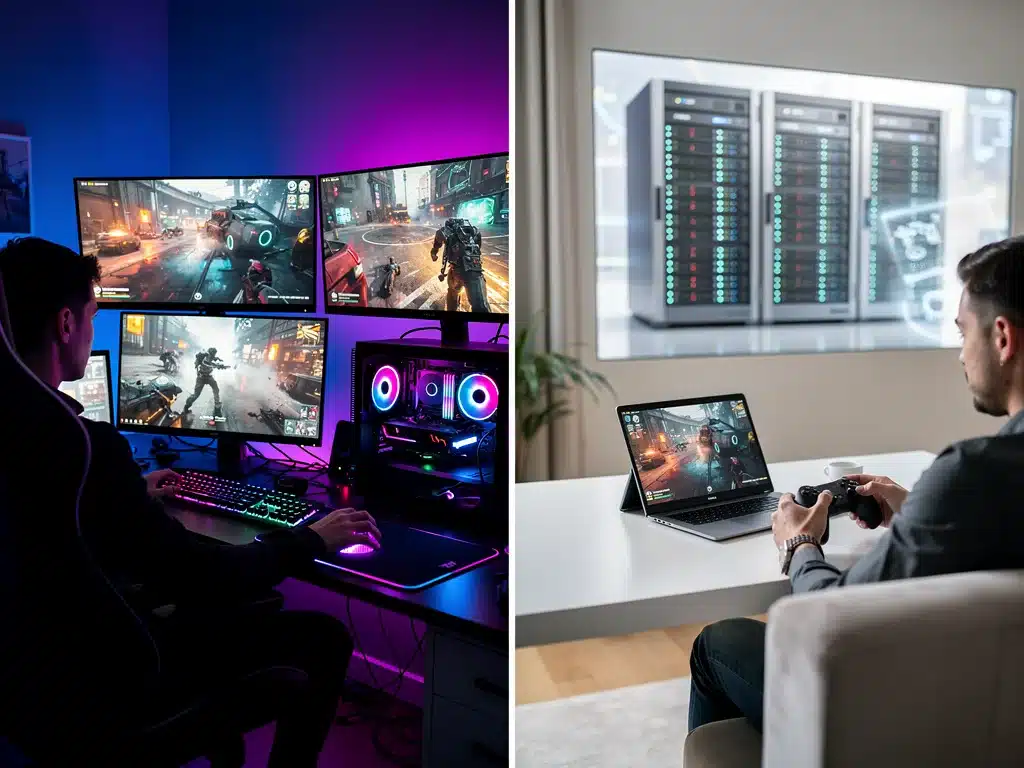
Local PC gaming continues to rely on dedicated hardware installed in the player’s own system, while cloud gaming moves much of the processing to remote servers and streams the result to the user’s device.
Each model has clear strengths and limitations. Understanding latency, frame rates, network requirements, visual fidelity, hardware costs, and flexibility can help explain where each approach performs best.
Advertisements
The Evolving Landscape of Gaming in 2026
The gaming landscape in 2026 continues to expand beyond traditional hardware. Powerful local PCs remain central to enthusiast gaming, while cloud platforms are making high-end experiences available on devices that would not normally run demanding games.
This shift has made the question of performance increasingly complex. Raw processing power remains important, but factors such as internet quality, server distance, encoding, and subscription structure now influence the overall experience.
The comparison therefore extends beyond graphics alone. Gamers must consider how each platform handles responsiveness, stability, accessibility, ownership, and long-term costs before deciding which environment better suits their priorities.
Methodology: Benchmarking 2026’s Gaming Platforms
The comparison is structured around three demanding game categories: a competitive shooter, an open-world RPG, and a graphically intensive simulation title. Each represents different performance requirements.
For local PC gaming, the benchmark setup uses a high-end system with a modern processor, graphics card, and sufficient memory to represent an enthusiast-class configuration.
Cloud gaming is evaluated under a stable 1 Gbps symmetrical fiber connection, with attention given to average frame rate, 1% low FPS, input latency, visual quality, and overall frame consistency.
Competitive Shooter: Latency Under Scrutiny
Competitive shooters place unusual pressure on latency because even small delays can influence aiming, movement, and reaction time. Stable high frame rates are particularly valuable in this type of game.
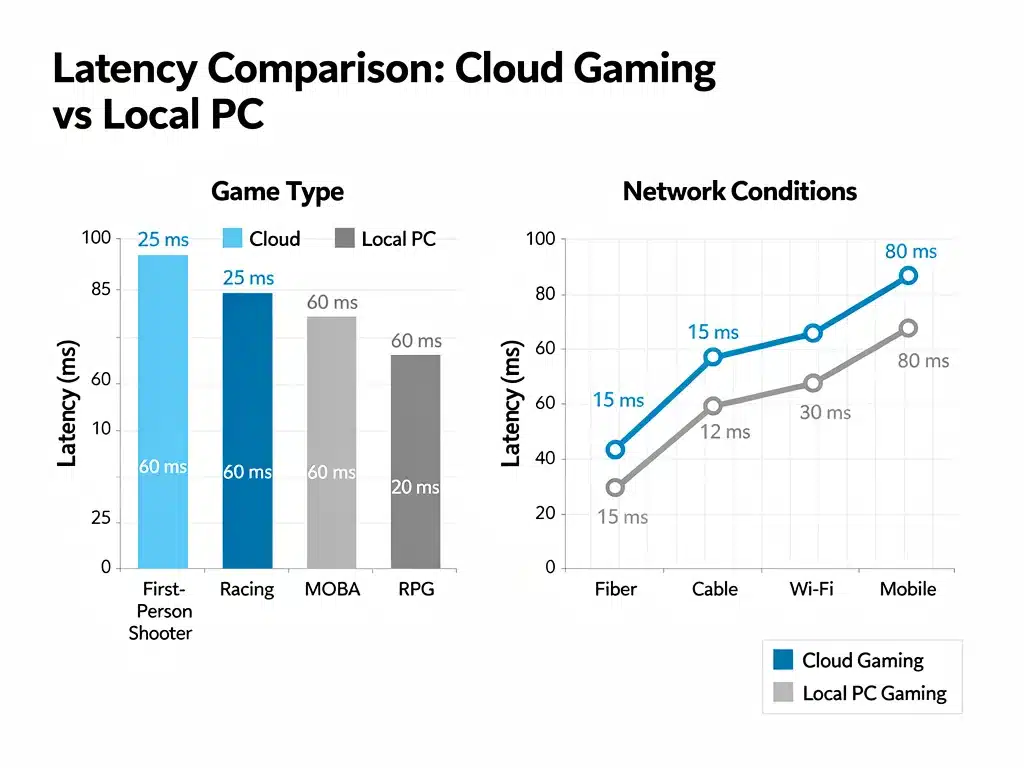
In the comparison, the local PC setup delivered input latency below 10 milliseconds in favorable conditions while maintaining frame rates above 200 FPS at 1440p. Direct processing eliminates the network stage required by cloud streaming.
Cloud gaming introduced additional delay, with the tested conditions producing latency in the 30-60 millisecond range. The experience remained playable, but the extra network and encoding steps created a measurable difference for competitive gameplay.
Open-World RPG: Visuals and Immersion
Open-world RPGs emphasize large environments, detailed textures, complex lighting, and extensive draw distances. These elements can place substantial demands on graphics hardware.
The local PC configuration delivered 4K output with frame rates reported in the 90-120 FPS range while maintaining high graphical settings. Dedicated hardware allowed the game to render without streaming compression.
Cloud gaming remained visually impressive but introduced occasional compression artifacts and less consistent frame delivery in demanding scenes. These differences were subtle but more noticeable when fine image detail was closely examined.
The Role of Network Infrastructure in Cloud Gaming
Cloud gaming depends heavily on the quality and stability of the internet connection. High bandwidth alone does not guarantee a smooth experience if latency, packet loss, or network congestion becomes significant.
Distance from the user to the data center also matters because each additional network hop can increase response time. Players located near well-connected servers may therefore experience considerably better results than users farther away.
Local PC gaming reduces this dependency because graphics rendering and input processing occur directly on the user’s system, although online multiplayer and game downloads still require connectivity.
Bandwidth Requirements and Stability
The original comparison places typical recommended bandwidth for cloud gaming at approximately 25-50 Mbps for 1080p streaming, with higher-quality 4K sessions potentially requiring 50-100 Mbps or more.
Connection stability can be just as important as raw download speed. Packet loss, jitter, or sudden latency spikes may lead to degraded image quality, delayed controls, or visible interruptions.
Cloud gaming can also consume substantial amounts of data during extended sessions. Users with restrictive data caps or less reliable broadband may therefore need to consider network limitations before relying on the platform regularly.
Hardware Investment vs. Subscription Model
Local gaming requires a significant initial investment because the user must purchase the processor, GPU, storage, memory, display, and other components required to run demanding games.
Cloud gaming changes this structure by providing remote access to powerful hardware through recurring subscription fees. This can lower the initial barrier for players who do not want to invest in a high-end gaming system.
The financial comparison becomes more complex over several years. Subscription payments accumulate continuously, while a local PC can remain usable for multiple purposes and may retain some resale or upgrade value.
Total Cost of Ownership Over Five Years
The source estimates a high-end gaming PC at approximately $2,000-$4,000 initially, with potential upgrades in the $500-$1,000 range every two or three years depending on performance expectations.
Cloud gaming subscriptions are estimated at around $10-$25 per month, translating to approximately $600-$1,500 over five years before considering the underlying internet service required for streaming.
The comparison is not purely financial because a local PC can also support work, editing, content creation, modding, and other applications. Cloud gaming subscriptions primarily provide access to the gaming service itself.
User Experience and Ecosystem Differences
Local PC gaming provides extensive control over hardware, graphical settings, peripherals, software, modifications, and game storefronts.
Cloud gaming generally provides a more controlled environment. The service determines available titles, hardware configurations, streaming limits, and many of the settings users can access.
These differences can appeal to different audiences. Players who value simplicity may prefer a managed cloud environment, while enthusiasts who enjoy customization may favor the freedom of a local machine.
Customization and Control
Local systems allow players to adjust resolution, frame rates, graphical presets, drivers, hardware components, cooling, storage, and peripheral configurations according to their preferences.
Cloud services simplify many of these decisions because the provider manages the underlying server hardware. The tradeoff is reduced access to advanced settings and system-level customization.
Modding can also be more limited in cloud environments. Local PCs generally provide broader access to community modifications, custom files, utilities, and independent software ecosystems.
Impact on Game Development and Innovation
The growth of cloud gaming could influence how developers approach hardware optimization. Centralized infrastructure may eventually make it easier to target specific server configurations rather than a wide range of individual consumer PCs.
At the same time, demand for powerful local computers continues to drive improvements in GPU and CPU technology. Hardware manufacturers compete to increase rendering performance, efficiency, and support for new graphical techniques.
These two development paths can coexist. Cloud infrastructure may expand accessibility while dedicated PC hardware continues pushing the upper limits of real-time gaming performance.
Potential Opportunities for Developers
Cloud infrastructure could provide developers with access to scalable computing resources that are difficult to reproduce on consumer hardware. This may eventually support new approaches to simulation or shared online environments.
Local hardware, however, provides predictable low-latency processing directly in the player’s home and allows developers to take advantage of increasingly powerful consumer graphics cards.
The future direction will depend on how developers balance accessibility, production costs, technical complexity, and demand from players who expect different levels of control and performance.
Latency Remains a Critical Difference
Latency remains one of the clearest distinctions between local and cloud gaming. On a local system, input can travel directly from the controller or keyboard to the machine running the game.
Cloud gaming adds several stages because the command must reach a remote server, be processed, rendered, encoded, transmitted back, and displayed on the user’s screen.
Modern networks can make this process surprisingly fast, but competitive players may still notice the additional delay in games where reaction time and precise input are particularly important.
Why Competitive Players Notice the Difference
A difference of several milliseconds may be irrelevant in slower games but become more noticeable in competitive shooters, fighting games, rhythm titles, and other experiences based on fast responses.
Higher refresh-rate displays can also make latency differences easier to perceive because the local system is capable of presenting new frames more frequently.
For casual or slower-paced gaming, the difference may have less practical importance. The relevance of latency therefore depends heavily on the type of game and the expectations of the player.
Visual Fidelity and Compression
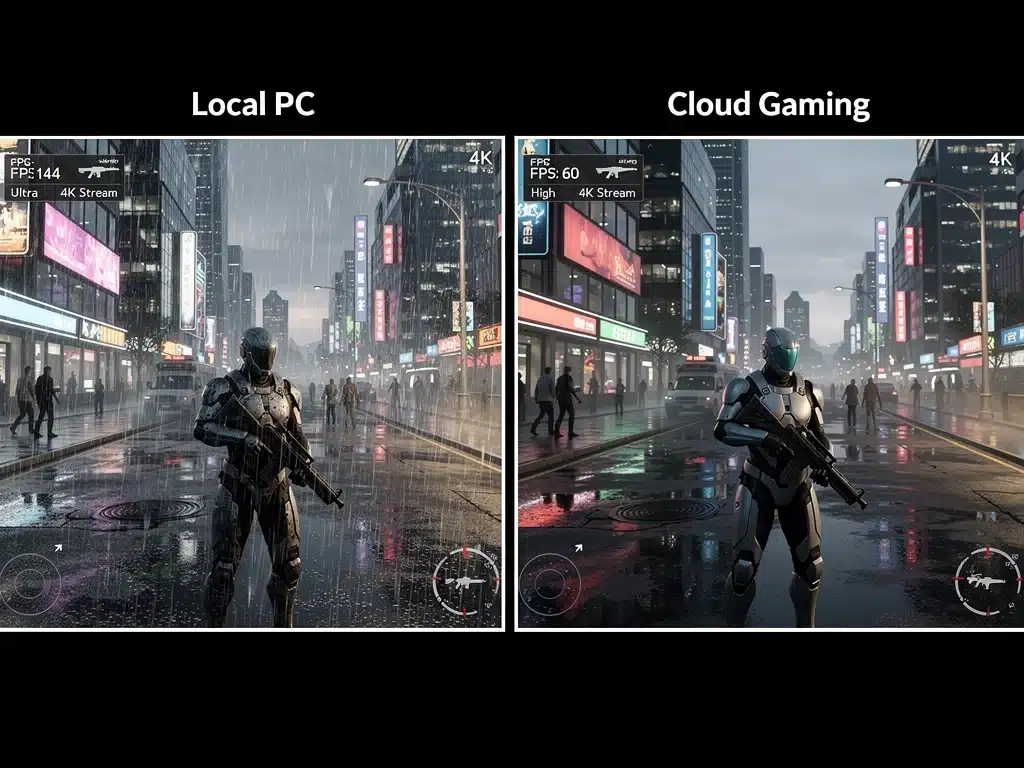
A local PC produces the game image directly and sends it to the connected display without compressing the entire visual output into an internet video stream.
Cloud gaming must encode each rendered frame before sending it across the network. Modern codecs can preserve impressive image quality, but compression may become visible in demanding scenes.
Fine textures, dark gradients, particle effects, foliage, and fast camera movements can make compression artifacts easier to notice, particularly on large high-resolution displays.
4K Gaming on Local and Cloud Platforms
High-end local hardware can render native 4K output without streaming compression, although actual frame rates depend on the game, graphical settings, and GPU being used.
Cloud platforms may deliver streams advertised at 4K resolution, but the final image is still affected by bitrate, compression, network conditions, and the service’s internal rendering configuration.
For many players, cloud image quality may be sufficient for comfortable gaming. Enthusiasts focused on maximum clarity and fine image detail may still favor local rendering.
Accessibility and Device Flexibility
One of cloud gaming’s strongest advantages is its ability to make demanding games available on relatively modest devices. Processing occurs remotely instead of depending entirely on local hardware.
Compatible laptops, tablets, televisions, handheld devices, and smartphones may therefore access games that would normally require a much more powerful computer.
This flexibility can be valuable for users who travel frequently, play in different rooms, or prefer not to maintain a dedicated gaming system.
Local Hardware Still Offers Broader Independence
Local gaming does not require continuous access to a cloud server for games that support offline play. Once installed, many titles can continue running even when the internet connection is unavailable.
The player also retains direct control over storage, installed software, hardware upgrades, and many aspects of the operating environment.
This independence can be important for gamers who prioritize ownership, long-term access, customization, or consistent performance regardless of network conditions.
Looking Ahead: 2026 and Beyond
Cloud gaming technology is likely to continue improving as networks, video codecs, server infrastructure, and edge computing become more advanced.
Local PC gaming will also evolve through more efficient hardware, improved rendering techniques, and technologies such as AI-assisted upscaling and frame generation.
The result may be a gaming market where neither approach replaces the other. Instead, players may choose between them according to performance expectations, cost, convenience, and hardware preferences.
Edge Computing and Cloud Latency
Moving cloud servers closer to users can reduce the physical distance that game data must travel. This is one of the reasons edge computing is relevant to future cloud gaming development.
Reducing network distance cannot remove every source of latency, but it can improve responsiveness when combined with efficient encoding and strong broadband infrastructure.
How widely these improvements benefit players will depend on regional data-center coverage and the quality of local internet infrastructure.
The Future of Gaming: A Hybrid Landscape?
The future may not require players to choose exclusively between cloud and local gaming. Some experiences could increasingly combine elements of both approaches.
A local machine might handle latency-sensitive rendering while cloud infrastructure supports additional services or computational workloads. Other models could combine streaming with locally stored assets.
This type of hybrid environment could provide greater flexibility, although the practical implementation would depend on game design, infrastructure, costs, and technical requirements.
Where Hybrid Gaming Could Fit
Hybrid systems could potentially allow developers to divide certain computational tasks between a local device and remote infrastructure rather than processing everything in only one location.
The concept could be particularly relevant to large online simulations or persistent environments where some calculations are already performed on remote servers.
However, the usefulness of this model will depend on whether the additional complexity produces meaningful advantages for players compared with simpler local or fully streamed solutions.
Which Approach Fits Different Types of Players?
Competitive players who prioritize extremely low latency and very high frame rates may place greater value on dedicated local hardware because it removes several network-dependent stages.
Players who value convenience, device flexibility, and lower initial hardware costs may find cloud gaming more attractive, particularly when they already have access to stable high-speed internet.
Neither profile represents every gamer. Budget, location, available devices, game preferences, internet quality, and interest in customization all influence which approach makes more sense.
Performance Versus Convenience
Local PC gaming emphasizes direct performance, customization, and control. The user accepts higher hardware costs in exchange for greater independence from streaming infrastructure.
Cloud gaming emphasizes convenience and accessibility. The player gives up some control and becomes more dependent on network conditions in exchange for easier access to powerful remote hardware.
The most appropriate option therefore depends on which tradeoffs matter most to the individual rather than on a single metric such as resolution or subscription price.
| Key Aspect | Performance Summary |
|---|---|
| Latency | Local PC minimizes network-dependent input delay, while cloud gaming introduces additional latency through streaming. |
| Visual Fidelity | Local rendering avoids full-frame streaming compression, while cloud gaming may show artifacts depending on bitrate and network conditions. |
| Cost Model | Local PC requires higher upfront hardware spending, while cloud gaming distributes costs through recurring subscriptions. |
| Accessibility | Cloud gaming can run demanding titles on more modest devices, while local PC gaming requires sufficiently powerful hardware. |
Frequently Asked Questions About Gaming Performance
What is the primary advantage of local PC gaming in 2026?
The main advantage is direct hardware processing, which can provide lower input latency, consistent visual quality, higher frame-rate potential, greater customization, and less dependence on internet conditions during locally rendered gameplay.
How does internet speed affect cloud gaming performance?
Cloud gaming depends on both bandwidth and connection stability, so high latency, packet loss, congestion, or inconsistent speeds can produce delayed input, stuttering, or compression artifacts even when nominal download speeds are high.
Is cloud gaming more cost-effective than local PC gaming?
Cloud gaming generally requires less upfront spending because users access remote hardware through subscriptions, while local PCs require a larger initial investment but provide hardware ownership and can serve many purposes beyond gaming.
Can cloud gaming match local PC graphics quality?
Cloud services can provide high-resolution streams with impressive image quality, but streaming compression, bitrate limits, and network conditions may still produce differences compared with graphics rendered and displayed directly by a high-end local PC.
What are the future trends for gaming platforms?
Cloud infrastructure, edge computing, improved streaming technology, faster local hardware, AI-assisted rendering, and potential hybrid models are among the developments that could continue changing how games are processed and delivered.
Perspectives
Cloud Gaming highlights two gaming models built around different priorities rather than a simple replacement of one technology by another.
Cloud gaming emphasizes accessibility, convenience, and reduced dependence on expensive local hardware, while local PC gaming continues to offer greater control, low latency, customization, and consistent image quality.
As both technologies develop, the most suitable option will continue to depend on the individual player’s internet connection, budget, preferred games, performance expectations, and desire for hardware ownership or flexibility.