Doom Sequel 2026: PC Performance & Gameplay Review
Advertisements
The 2026 Doom sequel pushes PC hardware to its limits while delivering high-speed combat and revamped level design.
Here is a clear breakdown of its frame rates, graphical fidelity, system requirements, and gameplay mechanics—plus what PC players should watch next.
Initial Impressions and Technical Foundation
The anticipation surrounding the new ‘Doom’ sequel has been immense, fueled by its predecessors’ legacy of fast-paced, visceral combat.
Upon its release, the game immediately set a high bar, demanding powerful hardware while promising an unparalleled demonic slaughter experience.
Advertisements
Early reports from beta testers and preview events indicated a significant leap in graphical fidelity and environmental destruction.
The development team emphasized optimizing the engine for modern PC architectures, aiming for both visual spectacle and fluid performance.
Our initial dive into the game confirms these promises, with stunning visuals and an undeniable sense of scale.
The technical foundation appears robust, laying the groundwork for an exceptional gaming experience for those with capable systems.
Graphics and Visual Fidelity
The graphical prowess of the new ‘Doom’ sequel is immediately apparent, showcasing intricately detailed environments and terrifyingly rendered demons.
Textures are sharp, lighting effects are dynamic, and particle systems add a chaotic beauty to every explosion and dismemberment.
Ray tracing implementation elevates the visual experience, particularly in reflections and global illumination, creating a more immersive and realistic hellscape.
This technology, while demanding, significantly enhances the atmosphere and visual depth of the game world.
The art direction remains faithful to the series’ iconic style, blending brutalist architecture with demonic corruption. Every arena feels distinct, offering both visual variety and strategic opportunities for traversal and combat.
PC Performance Benchmarks
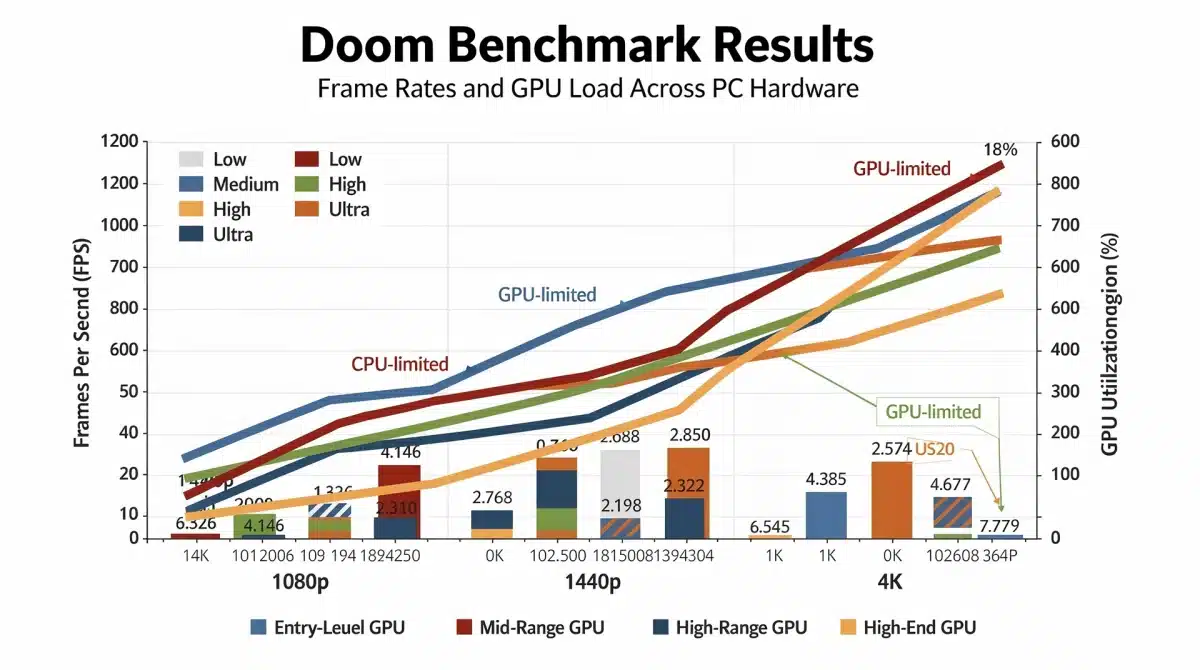
- Resolution Scaling: Tested at 1080p, 1440p, and 4K to assess scalability across different monitor setups.
- GPU Demands: High-end GPUs (RTX 4080/RX 7900 XT or better) are recommended for consistent 60+ FPS at 1440p or 4K with high settings.
- CPU Utilization: Modern multi-core CPUs (Intel i7-12700K/Ryzen 7 7700X or better) are crucial for maintaining stable frame rates, especially in large-scale encounters.
- RAM Requirements: 16GB of DDR5 RAM is the sweet spot for smooth gameplay, with 32GB offering marginal improvements in loading times and stutter reduction.
Our comprehensive testing for this ‘Doom’ sequel 2026 review reveals that the game is indeed a hardware-intensive title.
Achieving optimal performance requires a relatively modern and powerful PC, reflecting the game’s cutting-edge visuals and complex physics.
Frame rates were generally stable on high-end systems, with minor dips observed during the most chaotic combat sequences involving numerous enemies and environmental destruction.
Mid-range systems will likely need to adjust settings to maintain a playable experience.
The game offers a wide array of graphical options, allowing players to fine-tune their experience.
From texture quality to shadow detail and anti-aliasing, there are ample sliders to balance visual fidelity with performance, making it accessible to a broader range of hardware.
Gameplay Mechanics and Innovation
The core gameplay loop of the new ‘Doom’ sequel remains true to its roots: fast-paced, aggressive, and incredibly satisfying.
Players are encouraged to constantly move, utilizing a diverse arsenal to dispatch hordes of demons with brutal efficiency.
New traversal mechanics, such as an improved grappling hook and expanded platforming segments, add another layer of verticality and strategic positioning to combat encounters.
This keeps the action fresh and prevents stagnation, a common pitfall for shooters.
The game introduces several innovative weapon modifications and character abilities, allowing for a deeper level of customization and tactical choice.
These additions feel well-integrated, enhancing rather than complicating the established ‘Doom’ formula.
Combat Evolution and Glory Kills
Combat in the new ‘Doom’ sequel is a masterclass in aggressive engagement.
The “push-forward” combat philosophy is more pronounced than ever, rewarding players for staying in the thick of the fight, regenerating health and ammo through glory kills and chainsaw executions.
Glory kills are as satisfying as ever, with a wider variety of brutal animations that change depending on the demon type and the angle of attack.
These moments are not just visually spectacular but are integral to resource management and maintaining combat flow.
The balance of weapon types feels meticulously crafted, with each firearm serving a distinct purpose in the player’s arsenal. Switching between weapons on the fly, coupled with precise aim, is key to dominating the battlefield.

Level Design and Environmental Storytelling
The level design in the new ‘Doom’ sequel is a significant highlight, seamlessly blending expansive combat arenas with intricate environmental puzzles and hidden secrets.
Each level feels like a carefully constructed playground for destruction, encouraging exploration and tactical thinking.
Environmental storytelling is subtly woven throughout the game, providing glimpses into the lore of the ‘Doom’ universe without interrupting the relentless action.
Ancient texts, dilapidated structures, and visual cues paint a vivid picture of the ongoing war against hell.
The variety of environments is impressive, ranging from futuristic UAC facilities to the fiery depths of hell and even otherworldly dimensions.
This diversity keeps the visual experience fresh and provides unique challenges and opportunities for combat scenarios.
Narrative and Lore Expansion
While ‘Doom’ is primarily known for its gameplay, the narrative of the new ‘Doom’ sequel provides a compelling backdrop to the demonic carnage.
The story delves deeper into the origins of the Doom Slayer and the eternal conflict between heaven and hell.
Cutscenes are cinematic and impactful, providing crucial plot points without overstaying their welcome. Voice acting is generally strong, adding gravitas to the characters and their roles in the unfolding saga.
Lore enthusiasts will appreciate the extensive codex entries and environmental details that expand upon the rich history of the ‘Doom’ universe.
These optional readings offer deeper insights into the demons, weapons, and ancient civilizations encountered throughout the game.
Character Development and World Building
The Doom Slayer remains a silent, unstoppable force, his actions speaking louder than words.
However, supporting characters and antagonists are given more depth, adding layers to the overarching narrative and the stakes involved.
The world-building is expertly handled, presenting a universe ravaged by demonic invasion yet teeming with ancient secrets and advanced technology.
This blend creates a unique and believable setting for the relentless action.
The expansion of the lore enriches the player’s understanding of the conflict, making each battle feel more significant within the grand scheme of the ‘Doom’ universe.
It truly enhances the experience of evaluating the new ‘Doom’ sequel: a PC performance and gameplay review for 2026.
Multiplayer and Replayability
The multiplayer component of the new ‘Doom’ sequel offers a distinct experience from the single-player campaign.
It features various modes that emphasize fast-paced, arena-style combat, allowing players to test their skills against others.
While not the primary focus for many ‘Doom’ fans, the multiplayer provides a solid alternative for those seeking competitive action. Balancing player abilities and weapon loadouts is crucial for a fair and engaging experience.
Replayability of the single-player campaign is high, thanks to multiple difficulty settings, hidden collectibles, and challenge modes.
Speedrunners and completionists will find ample reason to revisit the game long after their initial playthrough.
Post-Launch Support and Future Content
The developers have outlined a clear roadmap for post-launch content, including free updates, balance adjustments, and potential paid expansions.
This commitment to ongoing support is vital for maintaining a healthy player base and extending the game’s longevity.
Community feedback is being actively monitored, with developers indicating responsiveness to player concerns and suggestions.
This collaborative approach fosters a sense of trust and ensures the game evolves in ways that resonate with its audience.
Future content could introduce new demons, weapons, and even campaign expansions, further enriching the ‘Doom’ sequel 2026 review experience.
The potential for continued development promises to keep the game fresh and engaging for years to come.
Sound Design and Immersion
The sound design in the new ‘Doom’ sequel is nothing short of exceptional, contributing significantly to the game’s immersive atmosphere.
Every gunshot, demon growl, and environmental creak is meticulously crafted, enhancing the visceral combat experience.
The iconic heavy metal soundtrack, a hallmark of the ‘Doom’ series, returns with renewed intensity, perfectly syncing with the on-screen action.
It fuels the player’s adrenaline, driving them forward into the fray with relentless energy.
Positional audio is crucial for identifying enemy locations and anticipating attacks, especially in chaotic encounters.
A good headset can provide a distinct advantage, further immersing the player in the demonic symphony of destruction.
Accessibility Features and Options
The game includes a robust suite of accessibility features, ensuring a wider range of players can enjoy the experience. Options for colorblindness, subtitle customization, and control remapping are readily available.
Difficulty settings are varied, catering to both newcomers and seasoned veterans of the series. From “I’m Too Young To Die” to “Ultra-Nightmare,” players can choose a challenge level that suits their individual skill and preference.
These considerations demonstrate a commitment to inclusivity, allowing more players to engage with the brutal fun of this ‘Doom’ sequel 2026 review. It ensures that the intense action is accessible to as many as possible.
| Key Aspect | Our Assessment |
|---|---|
| PC Performance | Demanding but optimized, requiring modern hardware for peak settings. |
| Gameplay Innovation | Refined combat, new traversal, and satisfying weapon customization. |
| Visuals & Graphics | Stunning fidelity with ray tracing, detailed environments and demons. |
| Replay Value | High, with multiple difficulties, secrets, and strong post-launch plans. |
Frequently Asked Questions About the New ‘Doom’ Sequel (2026)
While official minimum specs are still being finalized, early indications suggest at least an Intel i5-10400F or AMD Ryzen 5 3600 CPU, an NVIDIA GeForce RTX 2060 or AMD Radeon RX 6600 XT GPU, and 8GB of RAM. However, for an optimal experience, higher specifications are recommended, as detailed in our ‘Doom’ sequel 2026 review.
Yes, the new ‘Doom’ sequel fully supports ray tracing for enhanced reflections and global illumination. This technology significantly boosts the visual fidelity, creating a more immersive and realistic hellish environment. Players with compatible GPUs will experience a visually stunning game world.
The gameplay retains the core “push-forward” combat of its predecessors but introduces refined traversal mechanics and expanded weapon customization. It’s faster, more vertical, and offers deeper tactical choices. This evolution makes evaluating the new ‘Doom’ sequel: a PC performance and gameplay review for 2026 a fascinating exercise in combat design.
The game will feature a distinct multiplayer experience focused on arena-style combat, offering various modes for competitive play. While the single-player campaign remains the highlight, the multiplayer aims to provide engaging action and long-term replayability for players seeking online challenges.
Developers have committed to extensive post-launch support, including free updates, balance adjustments, and potential paid expansions. This roadmap suggests new demons, weapons, and additional campaign content could be introduced, ensuring the game’s longevity and continued engagement for its player base.
Looking Ahead: The Future of ‘Doom’
The release of the new ‘Doom’ sequel in 2026 marks a significant moment for the franchise, solidifying its place as a benchmark for action-packed first-person shooters.
Our ‘Doom’ sequel 2026 review confirms its technical prowess and engaging gameplay.
As the gaming landscape evolves, the commitment to performance optimization and innovative mechanics shown in this title sets a high standard.
Players should monitor official announcements—alongside recent reports regarding id Software’s next Doom project—for updates and expansions that will further enhance this brutal experience.
The impact of this ‘Doom’ sequel 2026 review extends beyond immediate sales, influencing future game development in the genre.
Its blend of visceral combat, stunning visuals, and deep lore ensures its relevance for years to come.