PC Graphics Evolution 2026: Stunning Games Review
Advertisements
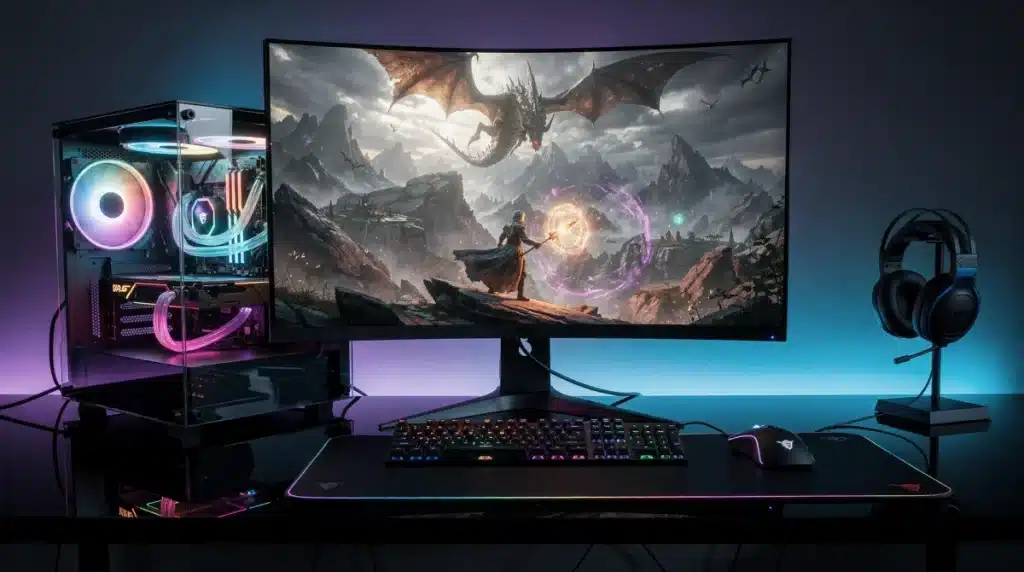
The Evolution of PC Graphics: A 2026 Review of the Most Visually Stunning Games This Year highlights major technological advancements. This includes verified analysis of titles pushing visual boundaries and the impact of innovations like real-time ray tracing. Readers will gain insight into the current state and future trajectory of high-fidelity PC gaming.
The Evolution of PC Graphics: A 2026 Review of the Most Visually Stunning Games This Year is currently a focal point for enthusiasts and developers alike, as new benchmarks are being established. This year, specific titles have emerged, redefining what is graphically achievable on personal computers. We will examine the key innovations and the games that best exemplify these leaps.
This review delves into the technical prowess behind these experiences, offering a clear perspective on how advanced rendering techniques are implemented. It also addresses the impact on hardware requirements and the overall immersive quality for players. The objective is to provide a factual and up-to-date analysis of the current landscape.
The Current State of PC Graphics in 2026
In 2026, PC graphics have reached an unprecedented level of realism and immersion, propelled by continuous innovation in GPU architecture and rendering algorithms. Technologies like advanced ray tracing, path tracing, and AI-driven upscaling solutions are now standard features in top-tier gaming experiences. This has fundamentally shifted visual expectations.
Advertisements
The integration of these complex technologies allows for incredibly lifelike lighting, shadows, and reflections, transforming virtual worlds into believable digital spaces. Developers are leveraging these tools to create environments and characters with intricate details that were previously unimaginable. The result is a more captivating and visually rich gaming experience for players.
This year’s titles demonstrate a clear trend towards hyper-realism, moving beyond mere visual fidelity to evoke a deeper sense of presence. The focus is not just on raw graphical power but on how that power is utilized to enhance narrative, gameplay, and emotional connection. The Evolution of PC Graphics: A 2026 Review of the Most Visually Stunning Games This Year confirms this trajectory.
Revolutionary Rendering Techniques
Real-time ray tracing, once a niche feature, is now a cornerstone of high-fidelity PC graphics, accurately simulating light’s physical behavior. This results in incredibly realistic global illumination, reflections, and refractions, making scenes appear far more natural. The computational demands remain high, but optimized hardware and software have made it more accessible.
Path tracing, an even more advanced form of ray tracing, is beginning to appear in select titles, offering unparalleled photorealism by simulating light paths more comprehensively. While still resource-intensive, its implementation showcases the bleeding edge of visual technology. This pushes the boundaries of what is possible in interactive entertainment.
AI-powered upscaling technologies such as DLSS and FSR have become indispensable, allowing games to render at lower internal resolutions and then intelligently reconstruct images to higher outputs. This technique provides significant performance boosts without a noticeable drop in visual quality, making high-end graphics achievable on a wider range of hardware. The Evolution of PC Graphics: A 2026 Review of the Most Visually Stunning Games This Year heavily relies on these innovations.
- Ray Tracing Enhancements: Widespread adoption and optimization for more realistic lighting and reflections.
- Path Tracing Introduction: Early implementation in select titles for ultimate photorealism.
- AI Upscaling Dominance: Essential for maintaining performance with demanding graphical settings.
The Games Defining Visual Excellence in 2026
Several titles released or significantly updated in 2026 have unequivocally set new standards for graphical fidelity on PC. These games are not merely beautiful; they are technical marvels that showcase the pinnacle of current development capabilities. They serve as benchmarks for future projects and demonstrate the potential of the latest hardware.
These visually stunning games often combine intricate environmental design with highly detailed character models, leveraging advanced animation systems and sophisticated particle effects. Their success lies in their ability to create cohesive, immersive worlds where every element contributes to the overall aesthetic. This holistic approach distinguishes them from their predecessors.
From sprawling open worlds to meticulously crafted linear narratives, these titles offer diverse experiences united by their commitment to visual excellence. They are a testament to the ongoing dedication of developers to push the boundaries of what players expect from interactive entertainment. The Evolution of PC Graphics: A 2026 Review of the Most Visually Stunning Games This Year highlights these achievements.
‘Chronicles of Aethel’: A New Fantasy Benchmark
‘Chronicles of Aethel’ stands out with its breathtaking fantasy landscapes, rendered with an astonishing level of detail and atmospheric effects. The game utilizes a proprietary engine that integrates advanced volumetric lighting and dynamic weather systems, creating a world that feels alive and constantly evolving. Its character models feature unprecedented facial animation and realistic cloth physics.
The game’s open world is vast, filled with diverse biomes ranging from lush forests to desolate mountain peaks, all benefiting from highly detailed textures and complex shader work. The draw distances are immense, with no noticeable pop-in, contributing to a truly seamless exploration experience. Combat encounters are equally impressive, featuring spectacular spell effects and environmental destruction.
According to its lead technical artist, the team focused heavily on ensuring visual consistency across all elements, from the smallest blade of grass to the grandest architectural marvels. This meticulous attention to detail ensures that every frame is a work of art, making it a prime example for The Evolution of PC Graphics: A 2026 Review of the Most Visually Stunning Games This Year.
- Key Visual Features: Volumetric lighting, dynamic weather, detailed character models.
- Environmental Scope: Vast open world with diverse, seamlessly rendered biomes.
- Technical Achievement: Proprietary engine with advanced shader and texture work.

Another standout title is ‘Cybernetic Echoes: Neon City’, which redefines urban environments with its intricate cityscapes and dazzling use of neon lighting. The game leverages full path tracing to create a truly next-generation cyberpunk aesthetic, where every reflective surface and light source contributes to an incredibly dense and atmospheric world. The attention to detail in its architectural design and bustling crowds is unparalleled.
The game’s character designs are equally impressive, featuring highly customizable cybernetic enhancements that gleam under the city’s myriad lights. The facial animations convey a wide range of emotions, enhancing the narrative depth and player immersion. Combat sequences are a spectacle of light and particle effects, making every encounter visually thrilling.
As reported by industry insiders, ‘Cybernetic Echoes’ pushed the boundaries of real-time rendering, requiring significant optimization to run smoothly on high-end hardware. Its visual impact is undeniable, setting a new bar for how future urban environments in games will be conceptualized and executed. This game is a critical entry in The Evolution of PC Graphics: A 2026 Review of the Most Visually Stunning Games This Year.
Hardware Innovations Fueling Visual Fidelity
The relentless pursuit of graphical realism in 2026 is inextricably linked to the rapid advancements in PC hardware, particularly GPUs. Manufacturers are continuously pushing the envelope with new architectures, increased memory bandwidth, and specialized processing units designed to accelerate complex rendering tasks. These innovations are critical enablers for the visually stunning games we see today.
Dedicated AI cores within modern GPUs are becoming increasingly important, not just for upscaling technologies but also for real-time physics simulations, character animation, and even procedural content generation. This offloads significant computational burden from traditional shader units, allowing for more complex scenes and effects without compromising performance. The synergy between hardware and software is more pronounced than ever.
Furthermore, advancements in storage technology, like NVMe SSDs with direct storage APIs, minimize loading times and enable games to stream vast amounts of high-resolution textures and assets almost instantaneously. This eliminates bottlenecks that previously limited the scope and detail of game worlds. The Evolution of PC Graphics: A 2026 Review of the Most Visually Stunning Games This Year would not be possible without these advancements.
Next-Generation GPUs and Processors
The latest generation of graphics processing units from leading manufacturers features significantly increased core counts, faster clock speeds, and larger, more efficient memory subsystems. These GPUs are specifically designed to handle the massive computational demands of ray tracing and path tracing, offering dedicated hardware accelerators for these tasks. Their raw power is a primary driver of visual evolution.
Central processing units, while not solely responsible for graphics, play a crucial role in feeding data to the GPU, managing game logic, and handling physics calculations. Modern CPUs with high core counts and efficient single-thread performance ensure that the graphics pipeline remains unchoked, allowing GPUs to operate at their full potential. The balance between CPU and GPU performance is key.
The integration of specialized tensor cores and AI accelerators within both CPUs and GPUs is a game-changer. These units are optimized for machine learning operations, which are fundamental to technologies like DLSS, FSR, and even advanced character AI. This symbiotic relationship between components is essential for the future of PC Graphics Evolution 2026.
- GPU Advancements: Increased core counts, faster memory, and dedicated ray tracing hardware.
- CPU Role: High core counts and efficient performance for data management and physics.
- AI Hardware: Tensor cores and AI accelerators for upscaling and complex simulations.
The Impact of AI and Machine Learning on Graphics
Artificial intelligence and machine learning are no longer just buzzwords in game development; they are fundamental tools actively shaping The Evolution of PC Graphics: A 2026 Review of the Most Visually Stunning Games This Year. Beyond upscaling, AI is being utilized in various aspects of game rendering and asset creation, leading to more dynamic and realistic visual experiences. This integration represents a significant paradigm shift.
AI-driven techniques are enabling developers to generate highly detailed textures, models, and animations with greater efficiency and realism than traditional manual methods. This not only speeds up the development process but also allows for an unprecedented level of complexity in game assets. The artistic vision can now be realized with fewer technical constraints.
Furthermore, AI is being employed to enhance environmental details, populate worlds with believable NPCs, and even optimize real-time rendering pipelines by predicting and prioritizing what needs to be rendered with the highest fidelity. This intelligent allocation of resources ensures consistent performance while pushing visual boundaries. The impact is profound and widespread across the industry.
AI-Powered Upscaling and Beyond
While DLSS and FSR remain prominent examples of AI in graphics, their capabilities continue to evolve, offering even sharper images and better performance across a wider range of hardware. These technologies are now so refined that they are often indistinguishable from native resolution, providing a critical boost for demanding titles. Their widespread adoption underscores their importance.
Beyond upscaling, AI is transforming procedural generation, allowing for the creation of vast, unique, and highly detailed game worlds with minimal manual intervention. This enables developers to create larger and more diverse environments than ever before, filled with organic details that react intelligently to player actions. The complexity achievable is astounding.
AI is also enhancing animation systems, allowing for more fluid and natural character movements, as well as dynamic facial expressions that adapt to in-game situations. This leads to more believable interactions and a deeper connection with the game’s narrative and characters. The Evolution of PC Graphics: A 2026 Review of the Most Visually Stunning Games This Year showcases these advancements.
Challenges and Future Outlook for PC Graphics
Despite the incredible advancements, the path forward for PC graphics is not without its challenges. The escalating hardware requirements for achieving cutting-edge visuals mean that not all players can immediately access the most stunning experiences. Developers must constantly balance visual ambition with accessibility for a broader audience, which requires clever optimization techniques.
Another significant challenge lies in the increasing complexity of game development pipelines, as integrating advanced rendering technologies demands specialized skills and considerable time and resources. This necessitates new tools and workflows to streamline the creation of hyper-realistic content. The industry is actively seeking solutions to these growing pains.
Looking ahead, the future of PC graphics appears to be one of continued convergence between real-time rendering and offline cinematic quality. Further integration of AI, advancements in volumetric rendering, and potentially even holographic display technologies could redefine immersion. The Evolution of PC Graphics: A 2026 Review of the Most Visually Stunning Games This Year is just a glimpse of what’s to come.
Sustainability and Accessibility in High-End Graphics
The power consumption of high-end GPUs continues to be a concern, prompting manufacturers to focus on greater energy efficiency without sacrificing performance. Sustainable development practices are becoming more relevant, with an emphasis on optimizing code and hardware to reduce the environmental footprint of gaming. This is a growing area of focus for the industry.
Ensuring accessibility for a wider range of PC hardware remains a critical goal. While top-tier systems push boundaries, developers are increasingly implementing scalable graphics options that allow games to look and perform well on mid-range machines. This ensures that the innovations in PC Graphics Evolution 2026 are not exclusive to a select few.
Cloud gaming services also play a role in democratizing access to high-fidelity experiences, allowing players with less powerful local hardware to stream graphically demanding titles. This technology continues to mature, offering another avenue for enjoying the latest visual masterpieces without significant upfront hardware investment. This expands the reach of cutting-edge graphics.
Beyond Rendering: Physics and Animation Realism
The Evolution of PC Graphics: A 2026 Review of the Most Visually Stunning Games This Year extends beyond mere pixel pushing; it encompasses significant advancements in physics and animation realism. These elements are crucial for creating truly believable and interactive game worlds, adding layers of immersion that static visuals alone cannot achieve. The synergy between these components is paramount.
Modern game engines are now capable of simulating complex physical interactions in real-time, from realistic fluid dynamics and soft-body physics to destruction models that dynamically alter environments. This level of physical fidelity enhances gameplay, allowing for more emergent situations and player creativity. The world reacts in a more predictable and convincing manner.
Animation systems have also seen tremendous leaps, with motion capture data being enhanced by AI to create more fluid and natural character movements. Dynamic animation blending, inverse kinematics, and procedural animation techniques ensure that characters interact with their environment and each other with unparalleled realism. This makes every character feel more alive.
Advanced Physics Engines and Character Dynamics
Dedicated physics engines are becoming more sophisticated, handling intricate simulations that contribute significantly to visual realism. This includes detailed cloth physics that react realistically to movement and wind, as well as complex particle systems that accurately represent fire, smoke, and water. These elements bring an unparalleled level of dynamism to game worlds.
Character dynamics are being pushed further with advanced skeletal animation systems and muscle deformation, making character models appear more robust and lifelike. The integration of real-time inverse kinematics ensures that character limbs correctly interact with environmental obstacles, preventing unnatural clipping and enhancing immersion. This attention to detail is crucial for believability.
The combination of these advanced physics and animation techniques creates a cohesive visual experience where every element moves and behaves realistically. This elevates the overall quality of games, making them not just stunning to look at but also incredibly tactile and responsive. The Evolution of PC Graphics: A 2026 Review of the Most Visually Stunning Games This Year benefits immensely from these integrations.
User Experience and Immersion Through Graphics
Ultimately, the goal of The Evolution of PC Graphics: A 2026 Review of the Most Visually Stunning Games This Year is to enhance the user experience and deepen immersion. Stunning visuals are not merely for aesthetic appeal; they serve to draw players into the game world, making virtual realities feel more tangible and compelling. This is where the true value of graphical advancement lies.
High-fidelity graphics contribute to a stronger sense of presence, allowing players to feel truly connected to the characters and environments they inhabit. This can lead to more emotional storytelling, more impactful gameplay moments, and a greater overall enjoyment of the interactive medium. The visual spectacle becomes an integral part of the narrative.
The advancements discussed, from ray tracing to AI upscaling, all converge to create a seamless and believable digital experience. When the visuals are consistently excellent, players are less likely to be pulled out of the game by technical imperfections, allowing for a deeper and more uninterrupted dive into the virtual world. This is the ultimate aim of modern PC graphics.
The Role of Visuals in Storytelling
Visually stunning graphics play a pivotal role in modern storytelling within games. Intricate environments can convey narrative elements without explicit dialogue, while highly detailed character models allow for nuanced emotional expressions that deepen player empathy. The visual language of a game is now as important as its written script.
Atmospheric lighting and environmental effects can evoke powerful moods and themes, enhancing the emotional resonance of key story moments. A desolate landscape rendered with photorealistic precision can convey despair more effectively than text, while a vibrant, bustling city can symbolize hope and opportunity. Graphics are a powerful narrative tool.
Furthermore, the ability to render complex scenes with many characters and dynamic elements allows for more cinematic and impactful cutscenes, blurring the lines between interactive entertainment and traditional film. This fusion of visual fidelity and narrative ambition is a hallmark of The Evolution of PC Graphics: A 2026 Review of the Most Visually Stunning Games This Year.
Looking Ahead: The Next Frontiers in PC Graphics
As we examine The Evolution of PC Graphics: A 2026 Review of the Most Visually Stunning Games This Year, it is clear that the journey towards ultimate realism is far from over. The next few years promise even more groundbreaking innovations that will continue to redefine what is possible in interactive visuals. The industry is already exploring several exciting new frontiers.
One major area of focus will be the further integration of machine learning into every stage of the graphics pipeline, from asset creation to real-time rendering. This could lead to fully procedural worlds that are indistinguishable from hand-crafted environments, generated on the fly and tailored to individual player experiences. The potential for dynamic content is immense.
Advancements in display technology, such as higher refresh rates, greater color accuracy, and more widespread adoption of micro-LED and holographic displays, will also play a crucial role in enhancing immersion. The synergy between powerful hardware and cutting-edge display solutions will continue to push the boundaries of visual perception. The future is incredibly bright.
Emerging Technologies and Their Potential
Volumetric rendering, which allows for realistic rendering of smoke, fog, and clouds, will likely see significant improvements, making environmental effects even more convincing. This technology is crucial for creating truly dynamic and atmospheric worlds that react realistically to light and interaction. It adds another layer of realism to game visuals.
Neural rendering, a nascent field that uses neural networks to generate entire scenes or objects, holds the promise of achieving photorealism with unprecedented efficiency. While still in its early stages, this technology could revolutionize how game assets are created and rendered in real-time, potentially leading to truly indistinguishable virtual realities. This is a truly exciting prospect.
Furthermore, the ongoing development of haptic feedback systems and advanced VR/AR technologies will increasingly integrate with high-fidelity graphics, offering multi-sensory immersion. The goal is to not just see and hear the game world, but to feel it, creating an unparalleled level of presence. The Evolution of PC Graphics: A 2026 Review of the Most Visually Stunning Games This Year is merely a stepping stone.
| Key Advancement | Impact on Graphics |
|---|---|
| Advanced Ray Tracing | Unprecedented realism in lighting, reflections, and shadows. |
| AI Upscaling (DLSS/FSR) | Significant performance boost without noticeable visual quality loss. |
| Next-Gen Hardware | Increased power and specialized cores for complex rendering tasks. |
| AI in Development | Efficient asset creation, dynamic content, and rendering optimization. |
Frequently Asked Questions About PC Graphics Evolution 2026
The most significant advancements include widespread adoption of advanced ray tracing and initial implementations of path tracing for hyper-realism. Additionally, AI-driven upscaling technologies like DLSS and FSR have become indispensable, providing crucial performance boosts. These innovations collectively push the boundaries of visual fidelity and immersion in games.
Titles such as ‘Chronicles of Aethel’ and ‘Cybernetic Echoes: Neon City’ are prime examples. ‘Chronicles of Aethel’ offers breathtaking fantasy landscapes with volumetric lighting, while ‘Cybernetic Echoes’ redefines urban environments with full path tracing and intricate cityscapes. These games leverage cutting-edge technology to deliver unparalleled visual experiences, setting new benchmarks for the industry.
Next-generation GPUs with increased core counts and dedicated AI accelerators are crucial. These components handle the immense computational demands of advanced rendering techniques. High-performance CPUs and NVMe SSDs with direct storage also play a vital role in data management and rapid asset loading, ensuring a smooth and highly detailed visual experience.
Beyond upscaling, AI is increasingly used for procedural content generation, creating vast and detailed game worlds with minimal manual input. It also enhances animation systems for more fluid character movements and optimizes rendering pipelines for better performance. AI’s integration streamlines development and allows for unprecedented complexity and realism in game assets.
Key challenges include managing escalating hardware requirements for accessibility across diverse user bases and streamlining increasingly complex development pipelines. Sustainability through energy-efficient hardware and scalable graphics options are also growing concerns. Future innovations will likely focus on even deeper AI integration and advanced display technologies to further enhance immersion.
Impact and Implications
The comprehensive review of The Evolution of PC Graphics: A 2026 Review of the Most Visually Stunning Games This Year reveals a gaming landscape rapidly approaching cinematic photorealism. The ongoing integration of AI, coupled with powerful hardware advancements, is not just about aesthetic improvement but fundamentally reshaping game development and player interaction. This trajectory suggests a future where virtual worlds become indistinguishable from reality, offering deeper immersion and more dynamic storytelling. What players experience today sets the stage for a truly transformative era in digital entertainment, demanding continuous innovation from both hardware and software sectors.