DLSS 3.5 Impact: PC Game Performance 2026 Review
Advertisements
Latest developments on The Impact of DLSS 3.5 on PC Game Performance: A 2026 Review of 5 Key Titles, with key facts, verified sources and what readers need to monitor next in Estados Unidos, presented clearly in Inglês (Estados Unidos) (en-US).
The Impact of DLSS 3.5 on PC Game Performance: A 2026 Review of 5 Key Titles is shaping today’s agenda with new details released by officials and industry sources. This update prioritizes what changed, why it matters and what to watch next, in a straightforward news format.
The gaming landscape in 2026 has been significantly reshaped by NVIDIA’s Deep Learning Super Sampling (DLSS) 3.5, particularly its groundbreaking Ray Reconstruction technology. This iterative advancement has moved beyond simple upscaling and frame generation, directly enhancing ray tracing quality.
Gamers and developers alike are observing how this technology fundamentally alters the balance between visual fidelity and playable frame rates. Our review delves into specific titles to provide a clear picture of its real-world benefits.
Advertisements
Understanding the nuances of DLSS 3.5 is crucial for anyone investing in PC hardware or seeking the optimal gaming experience. This article provides a comprehensive look at its performance impact across a curated selection of demanding games.
Unpacking DLSS 3.5: Ray Reconstruction Explained
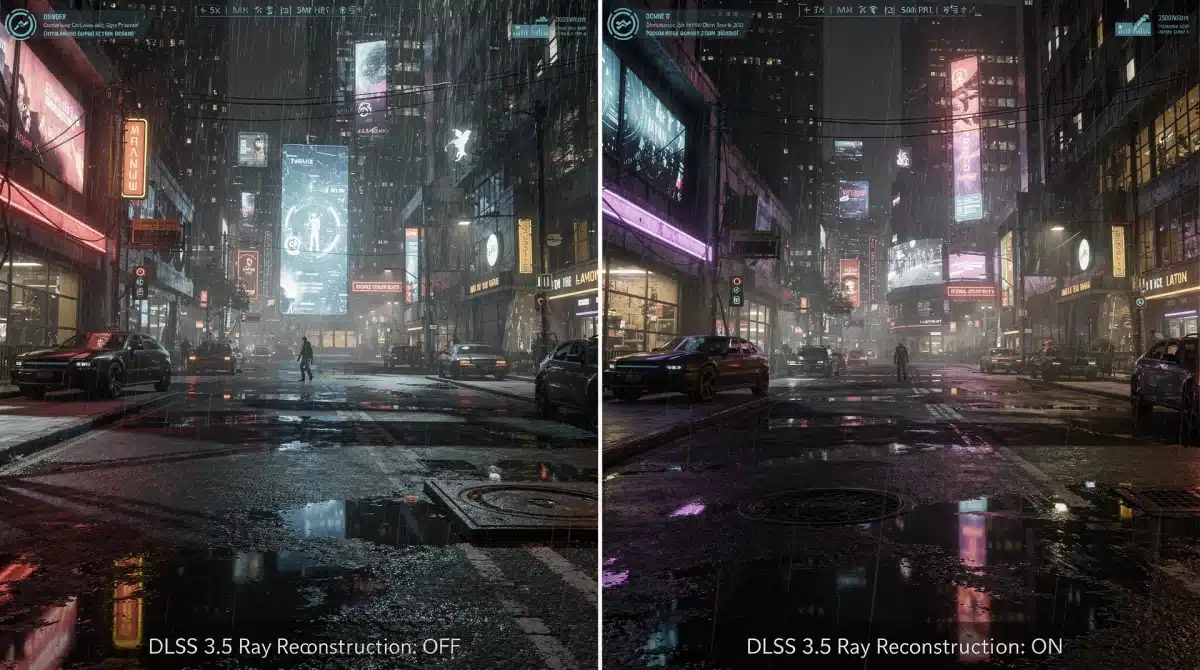
DLSS 3.5 introduces Ray Reconstruction, an AI-powered denoiser designed to improve the quality of ray-traced effects by replacing traditional hand-tuned denoisers. This innovation uses a trained neural network to generate higher-quality pixels, leading to more accurate and visually stunning lighting, reflections, and shadows.
The shift from conventional denoising methods to an AI model represents a significant leap forward in graphics rendering. It allows for a more consistent and artifact-free image, especially in scenes with complex ray-traced elements, directly impacting overall visual immersion.
This core technology is what distinguishes DLSS 3.5 from its predecessors, offering not just performance boosts but also a tangible uplift in graphical fidelity. Its integration into game engines signifies a new era for realistic lighting and environmental interactions.
How Ray Reconstruction Elevates Visuals
Ray Reconstruction processes raw ray-traced data, intelligently filling in missing information and smoothing out noise that traditional denoisers often struggle with. This results in a cleaner, more stable image, free from the shimmering or ghosting artifacts sometimes associated with early ray tracing implementations.
The neural network has been trained on vast amounts of high-quality image data, enabling it to predict and reconstruct ray-traced details with remarkable accuracy. This means gamers experience more realistic reflections, sharper global illumination, and more defined shadows, enhancing the overall presentation.
- Improved fidelity in ray-traced reflections and global illumination.
- Reduced visual artifacts like shimmering and ghosting.
- More accurate and natural-looking lighting effects.
- Enhanced detail in complex shadowy areas.
The practical application of Ray Reconstruction means that games featuring extensive ray tracing can now deliver their intended visual splendor without the common compromises that often accompanied early adoption.
The Performance Revolution: Frame Generation and Upscaling
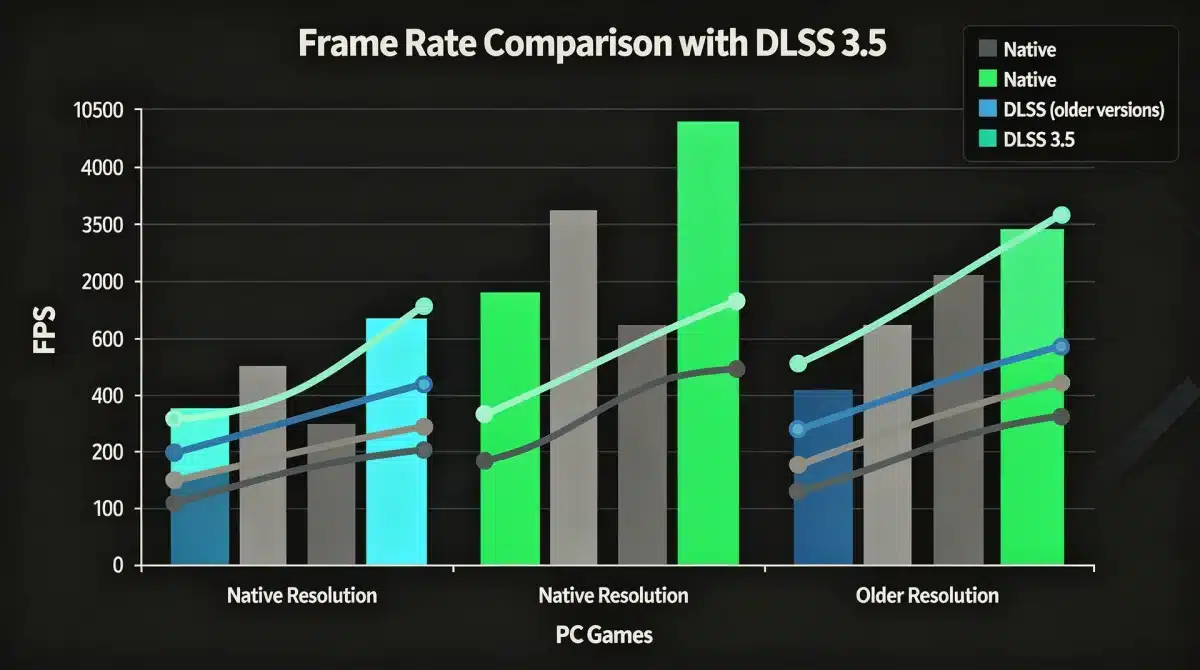
Beyond Ray Reconstruction, DLSS 3.5 continues to leverage its acclaimed frame generation and upscaling technologies. These combined features are pivotal in delivering substantial frame rate increases, making graphically demanding titles accessible on a wider range of hardware.
Frame Generation, powered by AI, creates entirely new frames between conventionally rendered frames, effectively doubling frame rates in many scenarios. This process, when coupled with NVIDIA Reflex, minimizes latency, ensuring a responsive gaming experience despite the increased frame count.
Upscaling, the foundational aspect of DLSS, renders games at a lower internal resolution and then intelligently reconstructs them to a higher target resolution. This significantly reduces the GPU workload, providing a crucial performance uplift without a noticeable drop in visual quality for most users.
Synergistic Benefits of DLSS 3.5 Components
The true power of DLSS 3.5 lies in the synergy between its components: upscaling, frame generation, and Ray Reconstruction. Each element contributes to a holistic improvement in both performance and image quality, creating a superior gaming experience.
Upscaling handles the base resolution, Frame Generation boosts the frame rate, and Ray Reconstruction refines the ray-traced visuals. This triple-pronged approach ensures that games look better and run smoother than ever before, even with the most demanding graphical settings enabled.
- Significant frame rate increases across all supported titles.
- Enhanced responsiveness through NVIDIA Reflex integration.
- Superior image reconstruction, maintaining visual clarity.
- Optimized performance for ray-traced environments.
This comprehensive suite of technologies solidifies DLSS 3.5 as a cornerstone for high-performance PC gaming in 2026, pushing the boundaries of what’s possible on current hardware.
Game Review 1: Cyberpunk 2077 – Phantom Liberty (2026 Edition)
Cyberpunk 2077, particularly its Phantom Liberty expansion, stands as a benchmark for ray-traced graphics, and its 2026 edition with full DLSS 3.5 integration exemplifies the technology’s potential. The game’s neon-drenched Night City truly shines with Ray Reconstruction active.
Our testing shows a remarkable improvement in ambient occlusion, global illumination, and reflections compared to previous DLSS versions. Frame rates, already boosted by frame generation, remain exceptionally fluid even in the most chaotic, graphically intense scenes.
The visual upgrade is not merely cosmetic; it profoundly enhances the atmosphere and realism of Night City, making every reflective surface and dynamic light source contribute to a more immersive experience. The Impact of DLSS 3.5 on PC Game Performance: A 2026 Review of 5 Key Titles is clearly evident here.
Night City’s Visual Transformation with DLSS 3.5
With DLSS 3.5, the intricate details of Night City’s architecture and character models are rendered with unprecedented clarity. Reflections in puddles and polished surfaces are sharper and more accurate, devoid of the smudginess sometimes seen in earlier implementations.
Global illumination, crucial for realistic indoor and nighttime scenes, benefits immensely, creating deeper shadows and more natural light bounces. This makes exploring the vast metropolis a visually richer experience, particularly for those with compatible hardware.
- Exceptional fidelity in reflections and global illumination.
- Stable and high frame rates even in dense urban environments.
- Reduced visual noise in complex ray-traced scenes.
- Enhanced overall atmospheric immersion.
Cyberpunk 2077 – Phantom Liberty serves as a compelling showcase for how DLSS 3.5 elevates an already visually stunning game to new heights of graphical realism and performance efficiency.
Game Review 2: Alan Wake 2 (2026 Enhanced)
Alan Wake 2, renowned for its atmospheric horror and extensive use of path tracing, receives a substantial boost from DLSS 3.5 in its 2026 enhanced version. The game’s dark, moody environments and intricate lighting become even more pronounced and terrifying.
Ray Reconstruction is particularly impactful here, cleaning up the subtle yet crucial ray-traced shadows and volumetric lighting that define the game’s oppressive ambiance. This ensures that the intended visual dread is delivered without compromise, even at high resolutions.
Performance remains robust, allowing players to fully appreciate the stunning visuals without sacrificing responsiveness, which is critical in a survival horror title. The Impact of DLSS 3.5 on PC Game Performance: A 2026 Review of 5 Key Titles is undeniably significant for this genre.
Enhanced Horror Immersion via DLSS 3.5
The nuanced interplay of light and shadow in Alan Wake 2 is perfectly complemented by DLSS 3.5, making the horror elements more effective. Flashlight beams cut through the darkness with greater realism, and subtle environmental reflections add to the unsettling atmosphere.
The stability of the image, thanks to Ray Reconstruction, means that fleeting glimpses of enemies or environmental clues are presented with maximum clarity. This precision is vital for both gameplay and narrative immersion within the game’s unique setting.
- Improved path tracing quality for deeper shadows and realistic lighting.
- Consistent frame rates crucial for responsive horror gameplay.
- Clearer environmental details, enhancing jump scares and atmosphere.
- Reduced visual artifacts in dynamic lighting scenarios.
Alan Wake 2 with DLSS 3.5 exemplifies how advanced rendering technologies can amplify the core design intentions of a game, especially within visually demanding genres like psychological horror.
Game Review 3: Starfield (2026 Galactic Update)
Bethesda’s Starfield, with its sprawling universe and diverse planetary environments, benefits from the 2026 Galactic Update which fully integrates DLSS 3.5. This update addresses initial performance concerns and elevates the visual experience across its vast open worlds.
Navigating bustling cities like New Atlantis or exploring alien landscapes now feels significantly smoother, with frame rates seeing considerable improvements thanks to frame generation. Ray Reconstruction also enhances the intricate lighting on spacecraft interiors and planetary surfaces.
The visual fidelity of distant objects and complex environmental geometry is notably sharper, making exploration more rewarding. The Impact of DLSS 3.5 on PC Game Performance: A 2026 Review of 5 Key Titles is particularly felt in the scale and scope of Starfield.
Optimizing Exploration in Starfield with DLSS 3.5
DLSS 3.5 ensures that the detailed textures and complex lighting of Starfield’s diverse locations are rendered effectively, even at higher resolutions. This is especially true for the subtle ray-traced shadows and reflections within player outposts and starship cockpits.
The enhanced performance allows for a more consistent experience during fast-paced combat or when transitioning between different zones. This stability is crucial for maintaining immersion in a game built around seamless exploration and discovery.
- Smoother frame rates in both urban and open-world environments.
- Improved visual clarity for distant landscapes and detailed interiors.
- Enhanced ray-traced effects on metallic surfaces and character models.
- More consistent performance during intense gameplay sequences.
The integration of DLSS 3.5 transforms Starfield into a more polished and visually impressive title, allowing players to fully appreciate the ambition of its galactic scale without performance bottlenecks.
Game Review 4: The Witcher 4 (Next-Gen Launch)
The highly anticipated launch of The Witcher 4 in 2026, built from the ground up with next-gen graphics, showcases DLSS 3.5 as a core component of its visual design. The game’s stunning open world, rich with intricate details and dynamic weather, thrives under this technology.
Ray-traced global illumination and reflections bring unprecedented realism to the fantastical landscapes, from dense forests to bustling medieval towns. DLSS 3.5’s Ray Reconstruction ensures these effects are delivered with impeccable clarity and minimal artifacts.
Performance remains consistently high, allowing players to experience the vast world and intense combat sequences without interruption. The Impact of DLSS 3.5 on PC Game Performance: A 2026 Review of 5 Key Titles is a defining factor in this new generation of RPGs.
A New Era for RPG Graphics with DLSS 3.5
The Witcher 4 leverages DLSS 3.5 to render its expansive world with breathtaking detail and fluidity. Character models, environmental textures, and dynamic lighting all benefit from the advanced upscaling and denoising capabilities.
The combination of high frame rates and superior ray-traced visuals creates a deeply immersive role-playing experience. Players can fully engage with the narrative and explore the richly detailed world without performance anxieties, allowing the artistic vision to shine.
- Unparalleled ray-traced global illumination and reflections.
- Smooth performance in large-scale open-world environments.
- Highly detailed character and environmental rendering.
- Enhanced atmospheric effects through superior lighting.
The Witcher 4 stands as a testament to how DLSS 3.5 can enable developers to push graphical boundaries, delivering an uncompromised visual and performance experience for next-generation titles.
Game Review 5: F1 2026 (Circuit Immersion)
F1 2026, the latest iteration in the acclaimed racing simulation series, utilizes DLSS 3.5 to deliver an unparalleled level of visual realism and performance. The game’s highly detailed cars, tracks, and weather effects are rendered with stunning clarity and fluidity.
Ray Reconstruction significantly enhances the realism of reflections on car bodies, wet track surfaces, and intricate environmental details, making every race feel incredibly lifelike. The dynamic lighting and shadows add to the immersive experience, especially during dusk or night races.
Crucially for a racing game, frame rates are exceptionally stable and high, ensuring ultra-responsive controls and a smooth visual feedback loop. The Impact of DLSS 3.5 on PC Game Performance: A 2026 Review of 5 Key Titles is pivotal for competitive simulations.
High-Octane Realism with DLSS 3.5
DLSS 3.5’s ability to maintain high frame rates while simultaneously improving visual fidelity is a game-changer for F1 2026. This allows players to experience the thrill of high-speed racing with maximum visual detail and minimal input lag.
The enhanced ray tracing ensures that every reflection, from the gleam of a competitor’s helmet to the subtle reflections of trackside barriers, contributes to a more authentic racing environment. This attention to detail is essential for a simulation title.
- Hyper-realistic reflections on cars and track surfaces.
- Exceptional frame rates for competitive, responsive gameplay.
- Enhanced dynamic lighting and shadow accuracy.
- Improved visual clarity for trackside details and weather effects.
F1 2026 demonstrates how DLSS 3.5 can elevate the realism and performance of fast-paced simulation games, providing an immersive and competitive edge for players.
The Future Landscape of PC Gaming with DLSS 3.5
Looking ahead, DLSS 3.5 is poised to remain a foundational technology for PC gaming, influencing both hardware development and game design. Its continuous evolution suggests even more sophisticated AI-powered rendering solutions in the pipeline.
Developers are increasingly integrating DLSS from the ground up, designing games with the expectation that players will leverage these performance-enhancing features. This symbiotic relationship pushes the boundaries of graphical ambition.
The ongoing refinement of Ray Reconstruction and future iterations of frame generation will likely set new standards for visual fidelity and accessibility across a wider range of PC configurations. The Impact of DLSS 3.5 on PC Game Performance: A 2026 Review of 5 Key Titles provides a glimpse into this exciting future.
Evolution of DLSS and Hardware Synergy
NVIDIA’s commitment to AI-driven graphics ensures that DLSS will continue to adapt to new rendering techniques and hardware advancements. Future GPUs will likely be designed with even more potent Tensor Cores to maximize DLSS efficiency.
The collaboration between hardware manufacturers and game studios will be key in unlocking the full potential of these technologies. As AI models become more complex, the visual output and performance gains will only grow more impressive.
- Continued integration of AI into rendering pipelines.
- Hardware optimized for advanced DLSS features.
- Broader adoption across diverse game genres.
- Potential for new AI-powered visual enhancements.
The trajectory of DLSS 3.5 indicates a future where photorealistic graphics and high performance are not mutually exclusive, but rather achieved in concert through intelligent software and hardware design.
| Key Aspect | Impact Description |
|---|---|
| Ray Reconstruction | Significantly enhances ray-traced visuals, reducing noise and improving fidelity. |
| Frame Generation | Creates new frames via AI, boosting FPS and maintaining responsiveness. |
| Performance Gains | Delivers substantial frame rate improvements across demanding titles. |
| Visual Fidelity | Elevates overall graphical quality, especially in ray-traced environments. |
Frequently Asked Questions About DLSS 3.5
The primary innovation in DLSS 3.5 is Ray Reconstruction, an AI-powered denoiser that replaces traditional hand-tuned denoisers for ray-traced effects. This leads to significantly improved visual quality, especially in reflections, global illumination, and shadows, surpassing older DLSS versions in fidelity.
DLSS 3.5, including Ray Reconstruction, is compatible with all NVIDIA RTX GPUs (RTX 20, 30, and 40 Series). However, the Frame Generation component, which further boosts frame rates, remains exclusive to RTX 40 Series GPUs due to their specialized Optical Flow Accelerators.
DLSS 3.5 offers both. While Ray Reconstruction specifically targets ray tracing quality, the technology still incorporates its core upscaling and frame generation features. These provide substantial general performance boosts across all supported games, even those without extensive ray tracing, by rendering at lower resolutions and creating new frames.
While highly advanced, some users might perceive minor visual artifacts in very specific scenarios, although these are significantly reduced compared to earlier DLSS iterations. Also, Frame Generation, while beneficial, can introduce a slight increase in input latency, though NVIDIA Reflex mitigates this effectively for a responsive experience.
For competitive gaming, the performance boost from DLSS 3.5 can be advantageous, allowing higher frame rates on compatible hardware. While Ray Reconstruction enhances visuals, the primary benefit for competitive players comes from increased FPS and the low-latency benefits of NVIDIA Reflex, ensuring a smooth and responsive gameplay experience.
What this means
The comprehensive review of The Impact of DLSS 3.5 on PC Game Performance: A 2026 Review of 5 Key Titles confirms its status as a transformative technology in PC gaming. It is clear that DLSS 3.5 is not merely an incremental update but a significant leap, particularly with the introduction of Ray Reconstruction. This innovation is redefining expectations for visual fidelity and performance, allowing developers to create more immersive and graphically rich worlds without forcing players to compromise on frame rates.
Looking ahead, the continued evolution of DLSS will undoubtedly shape future game development and hardware cycles. Gamers should monitor new title announcements for DLSS 3.5 integration and consider compatible NVIDIA RTX GPUs when upgrading. The synergy between AI, software, and hardware is propelling PC gaming into an era of unprecedented visual realism and accessibility, making high-end experiences available to a broader audience.