Ray Tracing in PC Games: 2026 Performance Deep Dive
Advertisements
Latest developments on Understanding Ray Tracing in PC Games: A 2026 Performance Deep Dive with 4 Examples, with key facts, verified sources and what readers need to monitor next in Estados Unidos, presented clearly in Inglês (Estados Unidos) (en-US).
Understanding Ray Tracing in PC Games: A 2026 Performance Deep Dive with 4 Examples is shaping today’s agenda with new details released by officials and industry sources. This update prioritizes what changed, why it matters and what to watch next, in a straightforward news format.
The landscape of PC gaming is continually evolving, with graphical fidelity pushing new boundaries. As we approach 2026, the discussion around Ray Tracing in PC Games intensifies, driven by hardware advancements and sophisticated software implementations. This deep dive will explore the current state and future trajectory of this transformative technology, providing critical insights for enthusiasts and developers alike.
Advertisements
Understanding its performance implications and the innovative techniques employed by game developers is crucial. We will examine how this technology delivers unparalleled visual realism and what challenges remain for widespread adoption. The goal is to provide a clear, factual overview of what to expect from Ray Tracing in PC Games by 2026.
The Evolution of Ray Tracing in PC Games
Ray tracing, once a futuristic concept confined to offline rendering, has rapidly transitioned into real-time applications within PC games. This shift has been powered by dedicated hardware cores in modern GPUs, fundamentally altering how light interacts with virtual environments. The journey from nascent integration to a cornerstone of visual quality has been swift and impactful.
Early implementations faced significant performance hurdles, often requiring substantial compromises in resolution or frame rates. However, continuous innovation in both hardware and software has steadily mitigated these issues. By 2026, we anticipate a much more refined and accessible experience for Ray Tracing in PC Games.
Developers are now leveraging these capabilities to craft truly immersive worlds, moving beyond traditional rasterization techniques. This evolution allows for dynamic lighting, realistic reflections, and accurate global illumination, creating scenes that are indistinguishable from reality in many instances.
Hardware Advancements Driving Ray Tracing
The introduction of specialized RT Cores in GPUs from NVIDIA, AMD, and Intel has been the primary catalyst for real-time ray tracing. These cores are designed to accelerate the complex calculations involved in tracing light paths, offloading the work from general-purpose shader units. This architectural innovation is essential for making ray tracing viable in interactive experiences.
Each successive generation of graphics cards brings more powerful and efficient RT Cores, along with improvements in memory bandwidth and processing power. These hardware leaps directly translate to better performance and visual quality in games utilizing ray tracing. The synergistic development of hardware and software is critical for realizing its full potential.
- NVIDIA’s RTX series continually refines its RT core architecture.
- AMD’s RDNA series integrates dedicated ray accelerators.
- Intel’s Arc GPUs also feature ray tracing units.
- Future architectures promise even greater efficiency.
Software Optimization Techniques
Beyond raw hardware power, software optimizations play a pivotal role in enhancing Ray Tracing in PC Games performance. Techniques such as denoising algorithms, temporal upscaling (like DLSS and FSR), and hybrid rendering approaches are crucial for maintaining playable frame rates. These methods reduce the computational load while preserving visual fidelity.
Denoising, for instance, intelligently reconstructs images from fewer ray samples, significantly cutting down render times. Temporal upscaling renders frames at a lower resolution and then intelligently reconstructs them to a higher target resolution, boosting performance without a noticeable drop in quality. Hybrid rendering strategically combines ray tracing with traditional rasterization, applying ray tracing only where its benefits are most pronounced.
- DLSS (Deep Learning Super Sampling) leverages AI for performance gains.
- FSR (FidelityFX Super Resolution) offers a broader compatibility solution.
- VRS (Variable Rate Shading) optimizes rendering by adjusting detail levels.
- Adaptive sampling reduces unnecessary ray calculations.
Performance Benchmarks for Ray Tracing in PC Games (2026 Outlook)
By 2026, performance benchmarks for Ray Tracing in PC Games are expected to show significant improvements over current standards. High-end GPUs will likely achieve consistent 4K resolution at 60 frames per second (FPS) with full ray tracing enabled in many titles. Mid-range cards will target 1440p at 60 FPS, making the technology accessible to a wider audience.
The key to these projections lies in continued hardware refinement and more efficient game engine implementations. Developers are becoming more adept at optimizing their titles for ray tracing, understanding how to balance visual impact with performance. This balance is crucial for delivering a smooth and enjoyable gaming experience.
Expect to see a greater standardization of ray tracing settings, with options that intelligently scale to different hardware configurations. This will ensure that gamers can enjoy the benefits of advanced lighting and reflections regardless of their specific GPU, albeit with varying levels of graphical intensity.
Expected Frame Rates and Resolutions
In 2026, a premium gaming PC equipped with a top-tier GPU should comfortably handle ray tracing at 4K resolution, targeting 60 FPS or higher in most demanding titles. This represents a significant leap from early implementations where 1080p at 30 FPS was often a struggle. The combination of more powerful RT Cores and advanced upscaling technologies will make this achievable.
For the mainstream market, 1440p at 60 FPS with ray tracing will become the new sweet spot. This resolution offers a substantial visual upgrade over 1080p while remaining within the performance capabilities of mid-range GPUs. Players will benefit from realistic lighting without needing to invest in the absolute latest and most expensive hardware.
- High-end GPUs: 4K @ 60+ FPS with full ray tracing.
- Mid-range GPUs: 1440p @ 60 FPS with balanced ray tracing.
- Entry-level GPUs: 1080p @ 30-60 FPS with optimized ray tracing.
Impact of Next-Gen APIs and Engines
Next-generation graphics APIs like DirectX 12 Ultimate and Vulkan Ray Tracing are fundamental to the widespread adoption and optimization of Ray Tracing in PC Games. These APIs provide developers with direct access to hardware ray tracing capabilities, enabling more efficient and powerful implementations. Game engines like Unreal Engine 5 and Unity are also integrating advanced ray tracing features, simplifying the development process.
Unreal Engine 5, for instance, with its Lumen global illumination system, provides highly realistic indirect lighting and reflections that can be further enhanced by hardware ray tracing. This integration means that future games built on these engines will inherently support advanced lighting models, making ray tracing a more seamless part of the development pipeline. The combination of robust APIs and powerful engines is accelerating the visual revolution.
- DirectX 12 Ultimate offers a unified feature set for developers.
- Vulkan Ray Tracing provides cross-platform compatibility.
- Unreal Engine 5’s Lumen and Nanite enhance visual fidelity.
- Unity’s HD Render Pipeline supports advanced lighting.
4 Key Examples Revolutionizing Gaming with Ray Tracing
By 2026, several game titles are set to exemplify the pinnacle of Understanding Ray Tracing in PC Games: A 2026 Performance Deep Dive with 4 Examples. These games will not just implement ray tracing as a feature, but integrate it as a core component of their artistic vision and gameplay experience. Each example showcases different facets of the technology, from hyper-realistic lighting to dynamic reflections and shadows.
These titles often serve as technical showcases, pushing the boundaries of what is graphically possible in interactive entertainment. They demonstrate how ray tracing can elevate immersion, storytelling, and the overall aesthetic quality of a game. Observing these examples provides concrete insight into the future of gaming visuals.
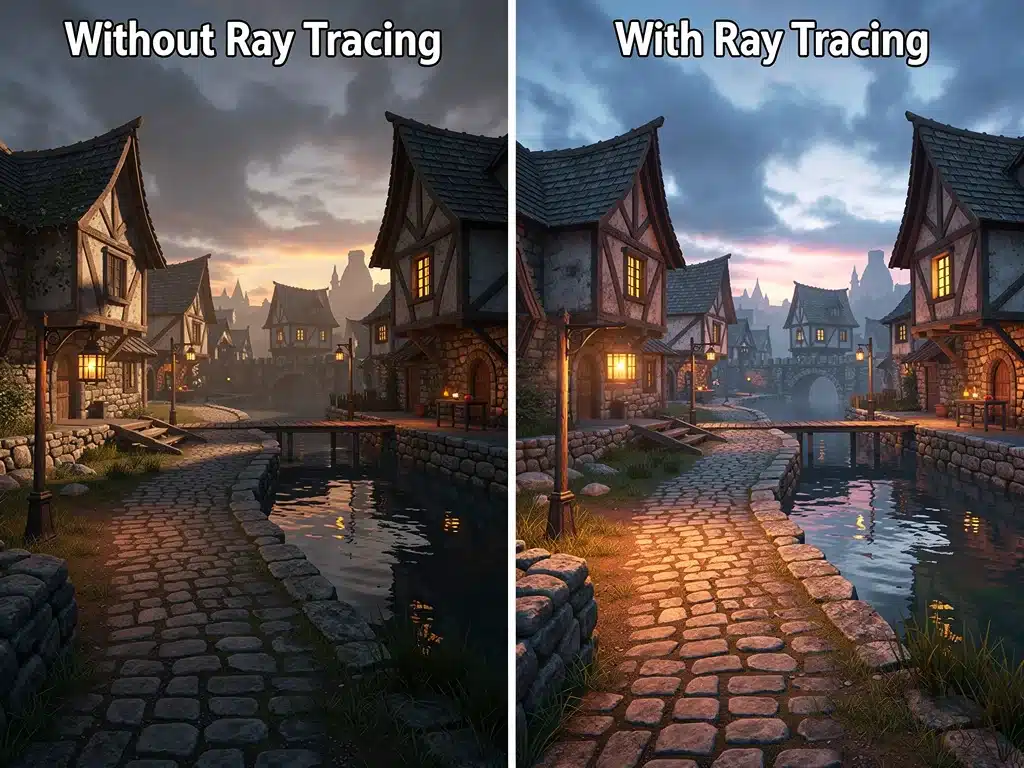
The focus is on how developers leverage ray tracing to create believable worlds and enhance player engagement. These four examples highlight the diverse applications and potential of the technology, illustrating its versatility and impact across various genres. From open-world epics to atmospheric horror, ray tracing is becoming indispensable.
Example 1: Cyberpunk 2077 (Post-2026 Update)
While already a benchmark for ray tracing, a hypothetical post-2026 update for Cyberpunk 2077 would push its path tracing implementation to new heights. Imagine Night City with even more realistic global illumination, where every neon sign and streetlamp casts perfectly accurate light and shadows, dynamically illuminating the complex urban environment. The reflections on wet streets and chrome surfaces would be virtually indistinguishable from reality, creating an unparalleled sense of immersion.
This advanced implementation would leverage future GPU capabilities, enabling real-time path tracing without significant performance compromises. The game would serve as a demonstration of how ray tracing can transform an already visually stunning world into something truly next-gen, setting a new standard for open-world environments. The intricate details of Night City would come alive with unprecedented realism, making every moment a visual spectacle.
Example 2: A Hypothetical Sci-Fi Epic
Consider a new sci-fi epic launching in 2026, built from the ground up with full ray tracing support. This game would feature vast, alien landscapes and futuristic cityscapes where every surface reflects light accurately, creating breathtaking vistas. The game’s narrative would benefit from dynamic lighting that changes based on environmental conditions, enhancing the atmosphere of exploration and discovery.
Imagine exploring a cavern system where bioluminescent flora casts soft, indirect light that bounces naturally off rock formations, or a space station where the metallic surfaces reflect distant stars and internal lighting with perfect precision. This level of visual fidelity would not just be cosmetic; it would contribute to the world-building and player immersion, making the alien environments feel tangible and real. Ray Tracing in PC Games is crucial for this.
Example 3: Atmospheric Horror Title
An atmospheric horror game utilizing advanced ray tracing could redefine the genre by 2026. Picture dimly lit corridors where light sources realistically scatter and bounce, creating terrifying shadows that stretch and recede as the player moves. The accurate global illumination would enhance the sense of dread, making players question what lurks in the periphery of their vision.
Reflections on polished floors or blood-soaked surfaces would reveal glimpses of unseen horrors, adding to the psychological tension. The precise lighting would allow developers to craft truly unsettling environments, where every flicker of light and every deep shadow contributes to the overall terrifying experience. Ray tracing would become an integral tool for manipulating player perception and fear, pushing the boundaries of interactive horror.
Example 4: Racing Simulator with Dynamic Weather
A racing simulator released in 2026 would leverage ray tracing to create hyper-realistic weather effects and vehicle reflections. Imagine racing through a rainstorm where raindrops refract light realistically, and the wet track reflects the surrounding environment with stunning accuracy. The car’s body would dynamically reflect passing scenery, other vehicles, and light sources, enhancing the sense of speed and immersion.
The sun glinting off puddles, the intricate reflections in rearview mirrors, and the subtle interplay of light and shadow on the car’s interior would all be rendered with unparalleled fidelity. This would not only make the game visually spectacular but also contribute to the realism of the driving experience, making players feel truly present on the track. Ray Tracing in PC Games elevates racing to a new level.
Challenges and Future of Ray Tracing in PC Games
Despite the immense progress, challenges remain for the widespread and seamless adoption of Ray Tracing in PC Games. Performance overhead, even with dedicated hardware, is still a consideration for many gamers, particularly those without the latest GPUs. Ensuring broad accessibility while delivering cutting-edge visuals remains a balancing act for developers.
Another hurdle is the increased development complexity. Integrating ray tracing effectively into game engines and pipelines requires specialized knowledge and significant computational resources during production. The learning curve for developers can be steep, impacting development timelines and budgets.
However, the future looks bright. Continued hardware innovation, coupled with more sophisticated software tools and standardized development practices, will gradually overcome these challenges. Ray tracing is not just a passing trend; it is a fundamental shift in rendering technology that will define the next generation of PC gaming visuals.
Overcoming Performance Bottlenecks
To overcome performance bottlenecks, future GPUs will likely feature even more advanced and numerous RT Cores, alongside improvements in memory architecture. Further optimization of upscaling technologies, such as DLSS and FSR, will continue to play a crucial role in boosting frame rates. These technologies are constantly evolving, providing better visual quality with less performance impact.
Additionally, game engines will become more adept at implementing hybrid rendering solutions, intelligently deciding when and where to apply ray tracing for maximum visual impact with minimal performance cost. This smart allocation of resources will ensure that games can run smoothly across a wider range of hardware configurations, making ray tracing a more accessible feature for all PC gamers.
- Next-gen GPUs with enhanced RT Cores.
- Advanced versions of DLSS, FSR, and XeSS for superior upscaling.
- More efficient hybrid rendering techniques in game engines.
- Cloud gaming platforms offering ray tracing without local hardware demands.
The Path to Universal Adoption
Universal adoption of Ray Tracing in PC Games hinges on several factors, including continued hardware affordability and standardization across platforms. As more games integrate ray tracing as a core feature, it will become an expected part of the gaming experience, rather than a niche enhancement. This will drive further investment and innovation in the technology.
The growing ecosystem of tools and middleware that simplify ray tracing implementation for developers will also accelerate adoption. As these tools mature, the complexity barrier will lower, allowing more studios to leverage the technology effectively. Ultimately, the visual benefits combined with improving performance will make ray tracing an indispensable component of modern PC gaming.
- Increased affordability of ray tracing-capable GPUs.
- Standardization of ray tracing features across gaming platforms.
- Easier integration into popular game engines and development tools.
- Growing consumer demand for realistic lighting and reflections.
The Impact on Game Design and Development
The rise of Ray Tracing in PC Games profoundly impacts game design and development, shifting creative possibilities and technical requirements. Designers can now rely on physically accurate lighting and reflections, freeing them from the constraints of pre-baked light maps and cubemaps. This allows for more dynamic and reactive environments that respond realistically to changes in light sources.
Developers must adapt their workflows, often embracing new lighting pipelines and optimization strategies. The ability to achieve photorealism with greater ease opens up new avenues for artistic expression and environmental storytelling. This technological leap encourages a re-evaluation of how virtual worlds are constructed and perceived.
The iterative process of game development benefits from real-time ray tracing, as lighting adjustments can be previewed instantly. This reduces iteration times and allows artists to fine-tune visual fidelity with unprecedented precision, leading to more polished and immersive final products. The entire creative process is enhanced by the power of ray tracing.
New Artistic Opportunities
Ray tracing unlocks new artistic opportunities, allowing game artists to create scenes with unparalleled realism and atmospheric depth. The accurate simulation of light, shadow, and reflections means that environments can convey mood and narrative more effectively. From subtle volumetric lighting to dramatic sun shafts, the visual storytelling potential is significantly enhanced.
Artists can focus more on the creative aspects of world-building, knowing that the underlying rendering technology will handle the complex light interactions authentically. This freedom allows for more intricate environmental details and a greater emphasis on crafting believable spaces. The visual fidelity delivered by Ray Tracing in PC Games is a powerful tool for artistic expression.
- Enhanced environmental storytelling through realistic lighting.
- Greater freedom for artists to design dynamic scenes.
- Improved visual consistency across different lighting conditions.
- Ability to create more complex and believable material properties.
Development Workflow Adjustments
Integrating ray tracing necessitates adjustments to existing development workflows. Game studios are investing in new tools, training, and talent to fully leverage the technology. This includes adopting new lighting pipelines, optimizing asset creation for ray tracing, and implementing advanced denoising and upscaling solutions. The shift requires a comprehensive approach to game development.
The initial investment in adapting to ray tracing pays off with higher quality visuals and more efficient iteration cycles in the long run. As the technology matures and tools become more user-friendly, these workflow adjustments will become standard practice, further solidifying ray tracing’s role in modern game development. The industry is collectively evolving to embrace these powerful rendering capabilities.
- Adoption of new lighting and rendering pipelines.
- Emphasis on creating physically accurate materials.
- Integration of advanced performance optimization techniques.
- Collaboration between artists and engineers for optimal results.
| Key Point | Brief Description |
|---|---|
| 2026 Performance Outlook | High-end GPUs target 4K@60FPS, mid-range 1440p@60FPS with Ray Tracing. |
| Hardware & Software Synergy | Dedicated RT Cores and upscaling tech like DLSS/FSR are crucial for efficiency. |
| Impact on Game Design | Enables hyper-realistic lighting, reflections, and dynamic environments for artists. |
| Key Game Examples | Cyberpunk 2077, hypothetical sci-fi, horror, and racing sims showcase its potential. |
Frequently Asked Questions About Ray Tracing in PC Games
Ray tracing is a rendering technique that simulates the physical behavior of light. In PC games, it traces individual light rays from the camera into the scene, calculating how they interact with objects to create realistic reflections, shadows, and global illumination. This results in highly accurate and immersive lighting effects.
By 2026, mid-range GPUs from 2024-2025 are expected to handle ray tracing at 1440p 60 FPS with optimizations. Older cards might struggle with the most demanding implementations, but continued software advancements like DLSS and FSR will help improve performance on a wider range of hardware.
The primary challenges include performance overhead, requiring powerful GPUs, and increased development complexity for game studios. Optimizing ray tracing to run smoothly across diverse hardware while maintaining visual quality and managing development costs are ongoing hurdles that the industry is actively addressing.
Ray tracing significantly enhances immersion by creating physically accurate lighting, shadows, and reflections that mimic real-world physics. This realism makes virtual environments feel more tangible and believable, improving the sense of presence and depth, and elevating the overall visual fidelity to a new level.
Upscaling technologies like DLSS and FSR are crucial for improving ray tracing performance. They render games at a lower resolution and then use AI or advanced algorithms to reconstruct the image to a higher target resolution, boosting frame rates significantly without a substantial loss in visual quality, making ray tracing more accessible.
Looking Ahead
The journey of Understanding Ray Tracing in PC Games: A 2026 Performance Deep Dive with 4 Examples reveals a technology rapidly maturing, poised to redefine visual standards. As hardware continues its relentless progression and software optimizations become more sophisticated, ray tracing will transition from a premium feature to an expected component of high-fidelity gaming. The impact on game design is profound, offering artists unprecedented tools for realism and immersion. Gamers should anticipate an era where virtual worlds are indistinguishable from reality, driven by these transformative advancements.